
Uganda | Park guide
Bwindi Impenetrable Forest
Half the world's mountain gorillas across misty, mountainous forest.
Bwindi Impenetrable National Park is one of Africa's most extraordinary forest destinations and the principal destination for mountain gorilla trekking in Uganda. Located in southwestern Uganda on the edge of the Albertine Rift, the forest is far more than a gorilla sanctuary: it is an ancient, exceptionally biodiverse mountain forest containing hundreds of bird, butterfly, plant and mammal species, including numerous Albertine Rift endemics. UNESCO recognizes Bwindi as a World Heritage Site because of its exceptional biodiversity and its importance for mountain gorilla conservation.
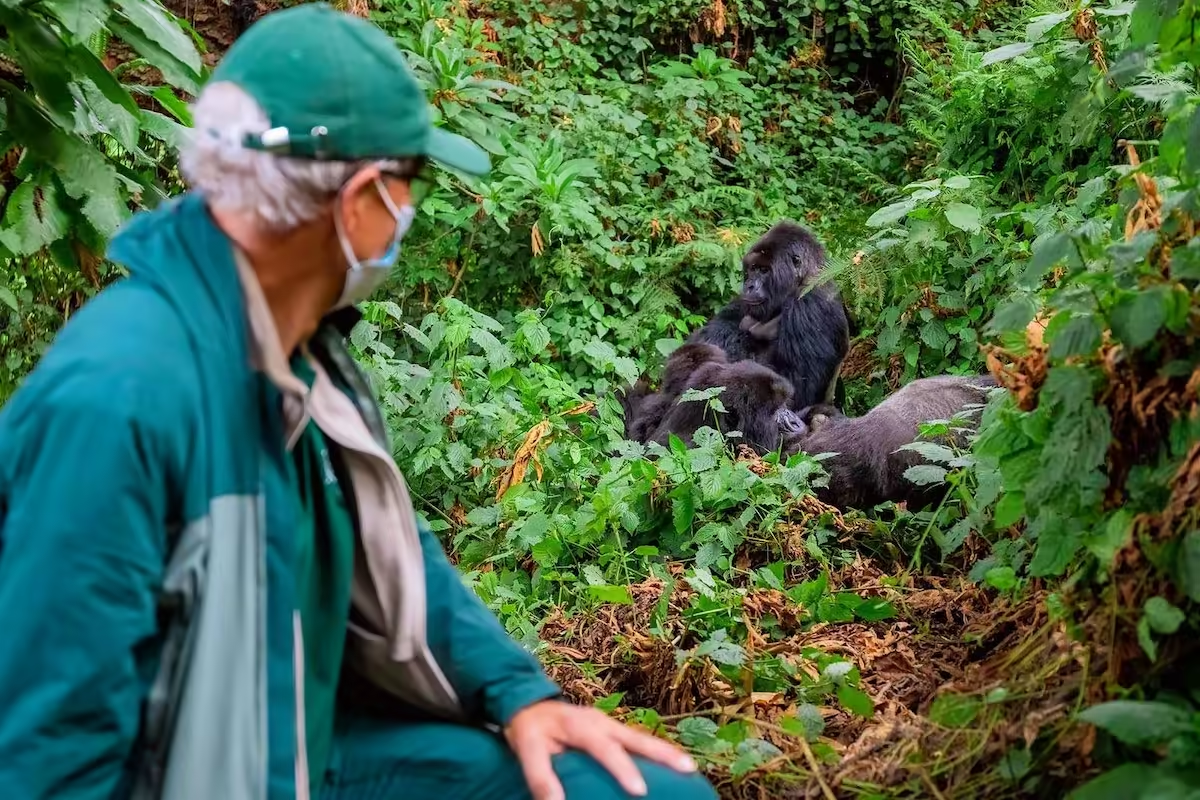
For travelers, however, the defining experience is entering this dense forest on foot in search of a habituated mountain gorilla family. The experience is very different from a conventional game drive. There are no roads taking you to the animals. You walk through steep, humid forest with trackers and guides, following signs of the gorillas until the family is located. UWA states that a normal trek can take approximately 2–7 hours, depending on where the gorillas are located, with up to one hour of observation once the family is reached.
Safaris visiting Bwindi Impenetrable Forest
Why Bwindi is different
Bwindi occupies a special ecological position where several major ecological zones meet. UNESCO describes the park as lying at the intersection of the Albertine Rift, Congo Basin and Eastern African ecological zones, with elevations ranging from approximately 1,160 to 2,706 metres. This variation helps explain the extraordinary mixture of lowland and montane forest habitats found within the park.
The forest contains more than 200 tree species according to UNESCO's detailed World Heritage assessment, including Albertine Rift endemics, as well as more than 100 fern species. It is also exceptionally important for birds and butterflies, with hundreds of forest bird species and numerous endemic species.
This matters when planning a safari because Bwindi should not be treated simply as a place to "see gorillas." The forest itself is the destination. The sounds, vegetation, mist, elevation changes, small forest creatures, bird calls and constantly changing trail conditions form part of the experience.
The mountain gorillas of Bwindi
Bwindi is home to roughly half of the world's mountain gorilla population. UWA's latest public conservation update notes that the last completed Bwindi census recorded 459 gorillas in 2018, while the results of the subsequent census work were still awaiting release in September 2026.
The recovery of Bwindi's gorilla population is one of Africa's important conservation stories. UWA reports that the population recorded in Bwindi increased from approximately 300 individuals in the first 1992 census to 459 in 2018. The wider global mountain gorilla population also increased substantially through coordinated conservation, veterinary monitoring, law enforcement, research and community involvement.
That conservation success is important to understand before trekking. Your permit is not simply an admission ticket. Gorilla tourism provides an economic mechanism supporting the protection of the forest and the communities around it.
Gorilla trekking: what actually happens
A typical trekking day begins at the relevant sector headquarters, where visitors receive a briefing before entering the forest.
You then hike with guides, trackers and other authorized personnel. The trackers may already be following the gorilla family's movements, allowing the trekking team to move toward the animals based on fresh signs.
The duration is unpredictable.
You may find the family relatively close to the trailhead, or you may need to walk for several hours through difficult terrain. UWA describes the overall trek as generally requiring moderate fitness and lasting approximately two to seven hours.
Once the gorilla family is found, normal tracking provides up to one hour of viewing time. This limitation is intentional: gorillas are wild animals and tourism must be managed to reduce disturbance and health risks.
The hour can feel surprisingly short. The experience is not about watching an animal perform for tourists. Gorillas may be feeding, resting, moving through vegetation, interacting with one another, grooming, displaying, playing or simply sitting quietly.
That unpredictability is part of what makes the encounter meaningful.
Gorilla trekking vs gorilla habituation experience
Bwindi offers two distinctly different experiences.
Standard gorilla trekking
Standard trekking is designed around finding a habituated gorilla family and spending up to one hour observing it.
It is the better choice for most travelers because it combines the core gorilla experience with a shorter and generally more accessible commitment of time and budget.
The trek itself can still be physically demanding. Paying for a standard permit does not mean the gorillas will necessarily be close to the trailhead.
Gorilla habituation experience
The habituation experience is different.
Instead of simply visiting a fully habituated family for the standard viewing period, visitors participate in a much longer encounter associated with a gorilla group undergoing habituation.
UWA's current tracking guidelines specify a maximum viewing period of four hours for gorilla habituation, compared with one hour for standard tracking.
The additional time makes habituation particularly attractive to photographers, wildlife enthusiasts, researchers and repeat gorilla trekkers who want to spend longer observing gorilla behaviour.
It should not, however, be marketed as an easier trek or as a guarantee of closer encounters. The gorillas remain wild animals, and their movements determine how the experience unfolds.
Current permit planning
UWA's tariff page now provides access to tariff changes for the 2026–2027 period.
For travelers planning in the current tariff period, published 2026/27 information indicates US$800 for standard gorilla tracking for foreign non-residents, with a reduced US$600 rate during April, May and November, while the habituation experience is listed at US$1,500 until the end of 2026. The applicable rate should always be confirmed against the official UWA tariff for the exact travel date before payment.
The permit includes important components of the experience. UWA's published tariff states that gorilla permit rates include the guide fee, park entrance for the day and a community development contribution.
The four gorilla trekking sectors of Bwindi
One of the most important things to understand when planning a Bwindi safari is that Bwindi is not one single trekking base.
UWA identifies four main trekking sectors:
- Buhoma
- Ruhija
- Rushaga
- Nkuringo
These sectors are separated geographically, so choosing a sector affects your accommodation, transfer time and the practical logistics of the trek.
Buhoma
Buhoma is the original and most established gorilla tourism sector.
It is particularly useful for itineraries combining Bwindi with the southern part of Queen Elizabeth National Park because the UWA route from the Queen Elizabeth area can pass through Ishasha, providing an opportunity to look for the area's famous tree-climbing lions before continuing toward Bwindi.
Buhoma is a strong choice for travelers who value established tourism infrastructure and want to combine gorilla trekking with a broader western Uganda safari.
Ruhija
Ruhija lies on the eastern side of Bwindi and is accessed from the Kabale direction.
UWA notes that the Kabale–Ruhija–Buhoma route follows winding murram roads and requires careful travel planning, particularly because road conditions can influence journey times.
Ruhija is also particularly attractive to birdwatchers because Bwindi's forest bird diversity is one of the major ecological reasons for protecting the forest.
Rushaga
Rushaga is in southern Bwindi and has become an important gorilla trekking base.
It is especially relevant for travelers approaching Bwindi from the Kisoro side or combining gorilla trekking with southwestern Uganda and Rwanda-related itineraries.
Rushaga is also the sector associated with the Gorilla Habituation Experience, making it particularly relevant for travelers who specifically want the extended gorilla experience.
Nkuringo
Nkuringo lies on the southern side of the forest and is known for dramatic terrain and elevated views.
It can be a particularly good choice for travelers who enjoy hiking and want a more physically active forest experience rather than simply selecting the most convenient lodge.
The important planning principle is simple: choose your trekking sector before choosing your lodge.
A beautiful lodge on the opposite side of Bwindi can create unnecessary early-morning transfers.
How difficult is gorilla trekking?
Gorilla trekking is not a technical mountaineering activity, but it can be physically demanding.
The challenge comes from a combination of:
- steep slopes
- muddy trails
- dense vegetation
- high humidity
- elevation
- uneven ground
- slippery sections after rain
- the possibility of walking for several hours
The key issue is that nobody can guarantee where the gorilla family will be on a particular morning.
A traveler who is comfortable walking for several hours on uneven terrain is generally better prepared than someone who relies only on gym fitness.
You do not need to be an elite athlete.
However, if you have limited mobility or are concerned about steep terrain, the trek should be discussed during itinerary planning so that the most suitable sector, support arrangements and pacing can be considered.
When is the best time to visit Bwindi?
Bwindi is a rainforest environment, so rain is possible throughout the year.
This means there is no simple "dry season equals no rain" rule.
The drier periods are generally preferred by many travelers because trails can be easier to manage, but the forest remains wet and conditions can change quickly.
The wetter periods can also offer advantages. Rain can make the forest more atmospheric and vegetation more lush, while lower-demand travel periods may sometimes provide more flexibility.
The most important consideration is therefore not simply whether it will rain.
It is whether the traveler is comfortable with the possibility of trekking through wet, muddy forest.
Wildlife beyond gorillas
Although gorillas dominate Bwindi's tourism identity, the forest supports a much broader ecosystem.
UNESCO records numerous mammals including:
- mountain gorillas
- chimpanzees
- L'Hoest's monkeys
- African elephants
- other forest mammals
The park also contains exceptionally rich bird and butterfly diversity. UNESCO identifies Bwindi as one of the most important montane forest areas in Africa for butterflies and notes its significance for Albertine Rift endemic birds.
For birders, Bwindi can therefore justify additional time beyond the gorilla trek.
Other activities in Bwindi
A gorilla safari does not have to end when the trekking day is over.
Depending on sector and current UWA arrangements, activities can include:
Forest walks
Nature walks allow travelers to experience Bwindi without making the gorillas the sole objective.
These are particularly worthwhile for travelers interested in plants, birds, butterflies and forest ecology.
Birding
Bwindi is one of Uganda's major birding destinations, particularly for travelers interested in Albertine Rift species.
Batwa cultural experiences
Community and cultural experiences around the forest can add an important human dimension to a Bwindi itinerary.
These experiences should be approached respectfully and should focus on genuine cultural interaction rather than treating communities as a tourist spectacle.
Buhoma–Nkuringo long walk
The forest's different sectors also make longer hiking experiences possible, including the Buhoma–Nkuringo route listed among UWA's activities.
Bwindi and conservation
Bwindi demonstrates why wildlife tourism and conservation cannot be separated.
The forest is surrounded by a densely populated agricultural landscape, making conservation especially dependent on relationships between the protected area and neighboring communities. UNESCO specifically identifies community benefits from gorilla and ecotourism as an important component of the site's long-term conservation prospects.
Uganda Wildlife Authority reports that it shares 20% of annual park revenue with communities surrounding protected areas. In 2025, UWA disbursed more than UGX 2.19 billion to communities around the Bwindi-Mgahinga Conservation Area for local development projects.
The relationship is particularly important because human health and wildlife health are connected. Mountain gorillas are closely related to humans, meaning respiratory and other diseases can pose serious risks.
Responsible trekking therefore means following the rules on distance, health, behaviour and interaction rather than trying to obtain a closer photograph.
Getting to Bwindi
Bwindi is in southwestern Uganda, and there is no single road journey that applies to every visitor because the park's sectors are accessed from different directions.
UWA gives several major approaches.
From Kampala through Kabale and Kanungu toward Buhoma, the road journey involves a long paved section followed by winding murram roads, and UWA recommends a 4WD vehicle.
Another useful route connects Queen Elizabeth National Park through Ishasha toward Buhoma. UWA describes the distance between Mweya and Buhoma as approximately 160 km, with the route involving dirt roads, while Ishasha is approximately 64 km from Buhoma.
This makes the Queen Elizabeth–Ishasha–Bwindi combination particularly logical for a western Uganda safari.
How many days do you need?
For a traveler whose main goal is gorilla trekking, 2–3 nights around Bwindi can work well.
However, a rushed one-night arrangement is rarely ideal because road transfers in southwestern Uganda can be lengthy and unpredictable.
A stronger itinerary could include:
2 nights Bwindi
- Arrival and forest/community experience
- Gorilla trekking
- Departure
For a more relaxed experience:
3 nights Bwindi
- Arrival
- Gorilla trekking
- Additional forest, cultural or birding activity
- Departure
For a broader Uganda safari, Bwindi can be combined with Queen Elizabeth National Park, Kibale Forest or other western Uganda destinations.
Suggested Bwindi safari packages
3-Day Uganda gorilla safari
- Day 1: Transfer to Bwindi
- Day 2: Gorilla trekking
- Day 3: Departure
Best for travelers whose main objective is seeing mountain gorillas.
4-Day Gorilla & Ishasha safari
- Day 1: Queen Elizabeth / Ishasha
- Day 2: Ishasha wildlife viewing and transfer to Bwindi
- Day 3: Gorilla trekking
- Day 4: Departure
This creates a stronger wildlife narrative by combining savanna wildlife with the rainforest.
5-Day Gorilla & Queen Elizabeth safari
- Day 1: Transfer to Queen Elizabeth
- Day 2: Game drive and Kazinga Channel
- Day 3: Ishasha and Bwindi
- Day 4: Gorilla trekking
- Day 5: Departure
This is one of the strongest combinations for travelers who want both classic African wildlife and mountain gorillas.
Bwindi gorilla trekking FAQs
Is gorilla trekking in Bwindi worth the cost?
For travelers whose priority is experiencing mountain gorillas in the wild, Bwindi offers one of Africa's most distinctive wildlife encounters.
The value is not comparable to paying for an ordinary game drive. A gorilla trek involves specialized conservation management, trained guides and trackers, strict visitor controls and protection of an endangered species in a difficult forest environment.
The experience also directly connects tourism revenue with conservation and surrounding communities. UWA's revenue-sharing programme and recent Bwindi-Mgahinga community disbursements demonstrate how tourism revenue can support development around the protected area.
How long does gorilla trekking take?
UWA states that gorilla tracking can take approximately 2–7 hours, depending largely on the location and movements of the gorilla family. The actual time spent with the gorillas during standard tracking is limited to one hour.
The important distinction is that the two-to-seven-hour figure refers to the overall trekking experience, not seven hours of standing with the gorillas.
Is Bwindi gorilla trekking difficult?
It can be.
The difficulty varies substantially from one trek to another because gorillas move through a mountainous forest rather than remaining at a fixed viewing point. Rain can make trails slippery, while elevation changes can make uphill sections strenuous.
Travelers should prepare for several hours of walking and should not judge the trek solely by the distance involved.
Which Bwindi sector is best?
There is no universally best sector.
Buhoma is attractive for established infrastructure and for itineraries connecting with Ishasha.
Ruhija is particularly interesting for birders and travelers coming through Kabale.
Rushaga is important for travelers interested in the Gorilla Habituation Experience.
Nkuringo suits travelers who enjoy dramatic terrain and a more hiking-oriented experience.
The best sector is the one that fits the permit availability, physical ability, accommodation and overall safari route.
Can children go gorilla trekking?
The minimum age and current UWA rules should be confirmed when booking because wildlife regulations can change. Families should also consider the physical demands of trekking rather than looking only at the age requirement.
Gorilla trekking involves several hours of walking through uneven terrain, so suitability depends not only on age but also on the child's ability to manage a demanding forest hike.
What should I wear for gorilla trekking?
Practical clothing is more important than fashionable safari clothing.
Recommended items include long trousers, long-sleeved shirt, sturdy hiking shoes, waterproof jacket, lightweight rain protection, gardening-style gloves for vegetation, socks that reduce friction, hat, small backpack, drinking water.
Because vegetation can be dense and wet, covering the arms and legs provides useful protection against scratches, insects and wet vegetation.
Can I guarantee seeing gorillas?
No wildlife encounter should be described as guaranteed.
However, the trekking system is designed around locating habituated families, with trackers working to establish their movements.
The more accurate promise is that you will enter the forest with an organized tracking team specifically searching for a habituated gorilla family, rather than simply hoping to encounter one by chance.
Can gorillas attack tourists?
Gorillas are powerful wild animals, but habituated gorillas are accustomed to controlled human presence.
Visitors must still follow the guide's instructions. The rules exist because the animals remain wild and because inappropriate human behaviour can create stress or dangerous situations.
The safest encounter is one in which visitors remain calm, maintain the required distance and allow the gorillas to decide how they move around the group.
Is gorilla trekking safe?
Gorilla trekking is a professionally managed wildlife activity, but it takes place in a genuine wilderness environment.
The main practical challenges are terrain, weather, physical exertion and close proximity to large wild animals.
Following UWA instructions and staying with the authorized trekking team are essential.
Can I combine Bwindi with Queen Elizabeth National Park?
Yes, and this is one of the most logical combinations in western Uganda.
The Ishasha sector of Queen Elizabeth lies on the route between parts of Queen Elizabeth and Bwindi, and UWA specifically highlights the possibility of passing through Ishasha while traveling toward Buhoma.
This allows travelers to combine savanna wildlife, tree-climbing lion territory and mountain gorillas in one itinerary.
Is Bwindi better than Rwanda for gorilla trekking?
Neither destination is automatically better.
Bwindi is particularly attractive to travelers who want a broader Uganda safari, because gorilla trekking can be combined with Queen Elizabeth, Kibale and other Ugandan destinations.
Rwanda can be attractive for travelers prioritizing Kigali access and shorter road logistics.
The right choice depends on budget, itinerary length, accommodation preferences and the other experiences the traveler wants to include.
Can I do gorilla trekking and a safari in the same trip?
Absolutely.
In fact, combining gorilla trekking with savanna wildlife often creates a more complete East African safari.
A strong Uganda itinerary can combine Queen Elizabeth → Bwindi or Kibale → Queen Elizabeth → Bwindi.
The first emphasizes classic wildlife plus gorillas, while the second adds chimpanzees and rainforest primates.
Is Bwindi only for gorilla trekking?
No.
The park is one of East Africa's important forest biodiversity destinations. Birding, forest walks, cultural experiences and longer hiking routes can add substantial value for travelers who have additional time.
A traveler who is passionate about birds, plants, primates or forest ecology can justify staying beyond the single gorilla trekking day.
How hard is the trek?
Moderate to tough: 1 to 5 hours on steep, muddy slopes at 2,000-3,000m. Porters carry packs and steady you - take one.
Honest grading: a Bwindi trek sits above a game drive and below a Kilimanjaro day - expect sustained inclines, roots as steps, and mud that can swallow a boot even in the dry season. Rangers set the pace to the slowest trekker. What breaks people is descent on wet soil, so poles matter more than fitness drills.
Uganda or Rwanda for gorillas?
Same species. Uganda permits cost 800 versus Rwanda's 1,500, and Uganda adds chimps plus savanna. Rwanda wins on transfer time.
One number settles it for most: the US$700 permit difference equals two extra lodge nights in Uganda or one Kibale chimp permit plus a Queen Elizabeth day. Choose Rwanda if your trip is under five days or you fly in and out of Kigali anyway; choose Uganda if you have a week and want the trek to sit inside a real safari.
How many days do we need in Bwindi Impenetrable Forest?
2 to 3 days.
Two nights is the minimum working format: one afternoon for transfer and briefing, trek day, contingency day. Add a night if the sector sits far from your arrival point - Rushaga and Nkuringo lie 5-6 hours from Queen Elizabeth, Buhoma 8-9 hours from Entebbe by road. Airstrips at Kihihi and Kisoro cut the road leg to under two hours.
When is the best time to visit Bwindi Impenetrable Forest?
Dry June to September and December to February for firm trails; permits 800 dollars, minimum age 15.
Bwindi has no true closed season - trekking runs year-round - but the rain calendar still shapes the choice: April-May is the long rains (lush, fewer bookings, leeches), October-November shorter showers. Dry months firm the trails but tighten permits. Birders should ignore season logic: the Albertine Rift endemics are resident, and migratory species arrive November-March.
What pairs well with Bwindi Impenetrable Forest?
Add Kibale chimps before and Queen Elizabeth savanna between.
Order matters: chimps before gorillas keeps the easy walking first, and a Kazinga boat day between the two forests breaks up the driving. Lake Mburo works as a shorter southern alternative to Queen Elizabeth if time is tight. Anything with water at the end - Lake Bunyonyi or Entebbe - turns the trek day into the peak rather than the finale.
What vaccinations and malaria prevention do we need?
Yellow fever certificates are required when arriving from endemic countries; malaria prophylaxis is recommended for most safari regions - discuss options with your doctor 6 to 8 weeks out. We brief every trip on water, sun and insect precautions.
CDC guidance for the region is precise. Yellow fever vaccination is recommended for all safari travelers and becomes a certificate requirement when you arrive via an endemic country such as Rwanda or Uganda. Routine boosters, hepatitis A, typhoid and hepatitis B round out the travel clinic list. Malaria transmission covers every game park below roughly 2,500 meters, the parasite is chloroquine resistant, and the preventatives that work are atovaquone-proguanil, doxycycline, mefloquine or tafenoquine, started before arrival and finished after. Book the clinic six to eight weeks out, and pack repellent with 20 percent DEET plus long sleeves for dusk.
What photography gear should we bring?
A 100 to 400mm zoom covers 90 percent of sightings; add a wide second body for landscapes. Beanbags beat tripods in vehicles. We provide charging setups and dust management briefings - tell us your kit and targets.
How do internal flights and luggage limits work?
Bush flights allow 15 to 20kg in soft duffels; lodges store hard cases free. We route connections with realistic margins and meet you at every airstrip - missed-connection cover is built into fly-in trips.
Is this trip private?
Yes - every itinerary here runs with your own vehicle and guide. No Mixed-group compromises unless you ask for a join-in price.
How fit do we need to be?
Game-drive safaris need no fitness. Trekking trips state their grade honestly - ask for the training notes.
What is NOT included that surprises first-timers?
International flights, visas, travel insurance (required), premium drinks, the balloon flight where offered, and tips. Our quotes line-item park fees and permits so the total you compare is the total you pay.
Put Bwindi Impenetrable Forest in the right place
Season, zone and camp selection by a specialist.