
Botswana | Park guide
Okavango Delta
A UNESCO water wilderness: mokoro canoes, island walks and predators.
The Okavango Delta is one of Africa's most extraordinary safari destinations: a vast inland wetland where clear river water spreads across the Kalahari instead of flowing into the sea. Located in north-western Botswana, the Delta transforms an otherwise dry landscape into a complex network of permanent waterways, seasonal floodplains, lagoons, islands, grasslands and woodland.
Unlike a conventional national park, the Okavango Delta is a large wetland ecosystem and UNESCO World Heritage Site containing a mosaic of protected areas, including Moremi Game Reserve, Wildlife Management Areas and tourism concessions managed by communities and private operators.
What makes an Okavango Delta safari particularly special is the timing of its water. The flood arrives during Botswana's dry season, when much of the surrounding landscape is becoming increasingly dry. This creates an unusual ecological cycle in which wildlife responds to water arriving when it is most valuable.
Safaris visiting Okavango Delta
Why the Okavango Delta is different
Many African safari destinations are built around dry savannah, woodland or open grassland. The Okavango offers all of these landscapes, but places them within a functioning wetland system.
The Delta can expand and contract considerably depending on water conditions, with Botswana Tourism describing the wider system as ranging from roughly 15,000 km² during drier periods to around 22,000 km² during wetter periods.
The UNESCO World Heritage property itself covers more than 2 million hectares, encompassing permanent swamps and extensive seasonally flooded grasslands.
The result is a safari environment where a single day can involve:
- a morning game drive through dry woodland
- elephants crossing flooded plains
- hippos in permanent channels
- red lechwe moving through shallow water
- a mokoro gliding between papyrus-lined waterways
- a boat excursion at sunset
- lions hunting on an island or floodplain
- spectacular birdlife around lagoons and channels
This combination of water, wildlife and wilderness is the foundation of the Okavango experience.
Where is the Okavango Delta?
The Okavango Delta lies in north-western Botswana, within the Kalahari Basin.
The Okavango River originates far to the north in the Angolan highlands before flowing through the region and eventually reaching Botswana. Rather than continuing toward an ocean, its waters spread into the Kalahari sands, creating one of the world's major inland delta systems.
Botswana Tourism divides the wider Delta into three broad geographical areas:
- The Panhandle
- The Delta
- The Drylands
The Panhandle is the relatively narrow upper section where the Okavango River enters Botswana. Farther south, the river spreads into the fan-shaped Delta, creating channels, lagoons, floodplains and islands.
Further southeast, increasingly dry terrain creates an important contrast between wetlands and Kalahari woodland.
The Okavango flood: why the water arrives during the dry season
The Okavango's hydrology is one of the main reasons the destination is so unusual.
Rain falls in the Angolan highlands during the southern African summer. Water then travels downstream through the Okavango system before reaching Botswana months later.
Consequently, the Delta's major flood generally develops during Botswana's dry winter period, rather than during its local rainy season. UNESCO identifies this annual flood pulse as one of the defining ecological characteristics of the Delta.
This creates an extraordinary reversal: Botswana becomes drier, surface water elsewhere becomes scarcer, Okavango floodwaters arrive, and wildlife concentrates around the Delta's water and productive floodplains.
The exact timing and extent of flooding vary from year to year, so travelers should not expect every channel or island to have identical conditions on every visit.
Okavango Delta wildlife
The Delta supports an exceptional variety of wildlife because it contains many different habitats within one connected ecosystem. UNESCO records approximately:
- 130 mammal species
- 482 bird species
- 89 fish species
- 64 reptile species
- more than 1,000 plant species within the World Heritage property
Botswana Tourism's broader Okavango overview records even higher numbers for the wider region, illustrating how species totals depend on the geographical area and methodology being considered.
Elephants
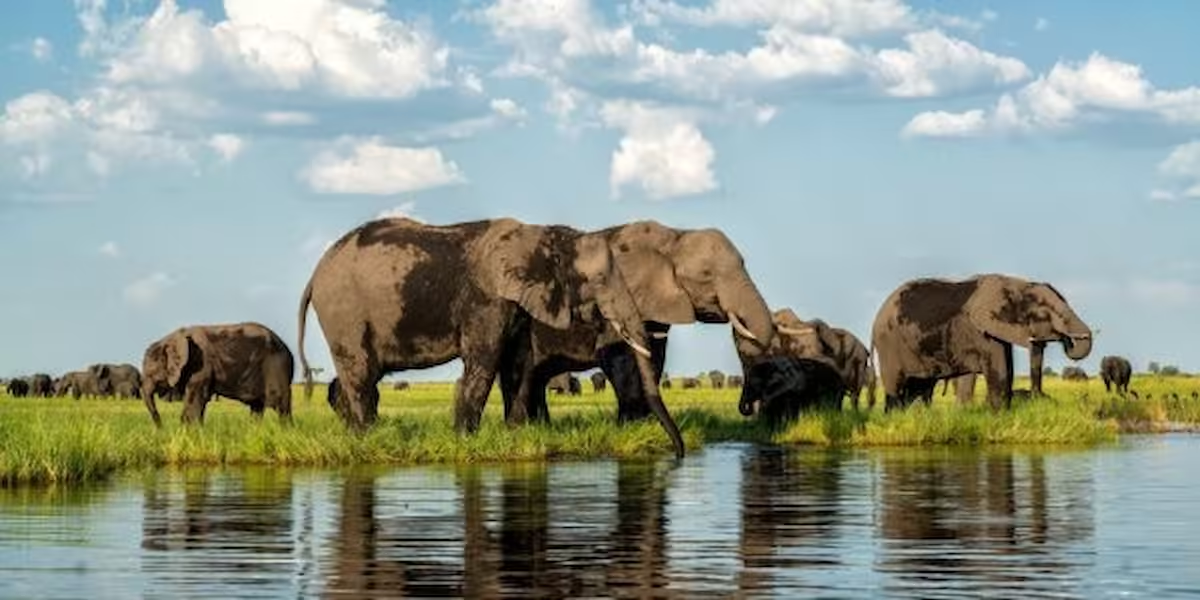
Elephants are among the Delta's most recognizable animals. They are particularly well suited to the combination of woodland, floodplain and permanent water. Seeing elephants moving through shallow channels, feeding beside lagoons or crossing open floodplains gives the Okavango a character that is very different from a conventional dry-season savannah safari.
Botswana supports the world's largest elephant population, and UNESCO identifies the Okavango as a core area for the species' survival.
Buffalo
Large buffalo herds can occur in the Delta, particularly where productive floodplain and dryland habitats provide suitable grazing.
Their movements are strongly influenced by seasonal water and food availability, meaning the location and size of herds can change considerably during the year.
Lion
The Okavango supports important lion populations, and lions are among the major predators travelers may encounter.
The Delta's combination of permanent water, floodplain and islands creates unusual hunting environments. Some prides operate around relatively open floodplain areas, while others use woodland and dryland habitats.
Leopard
Leopards are present throughout suitable habitats but are naturally more difficult to find than some of the Delta's larger, more visible animals.
Their solitary and nocturnal behavior means sightings can depend heavily on the guide, location and timing of the safari.
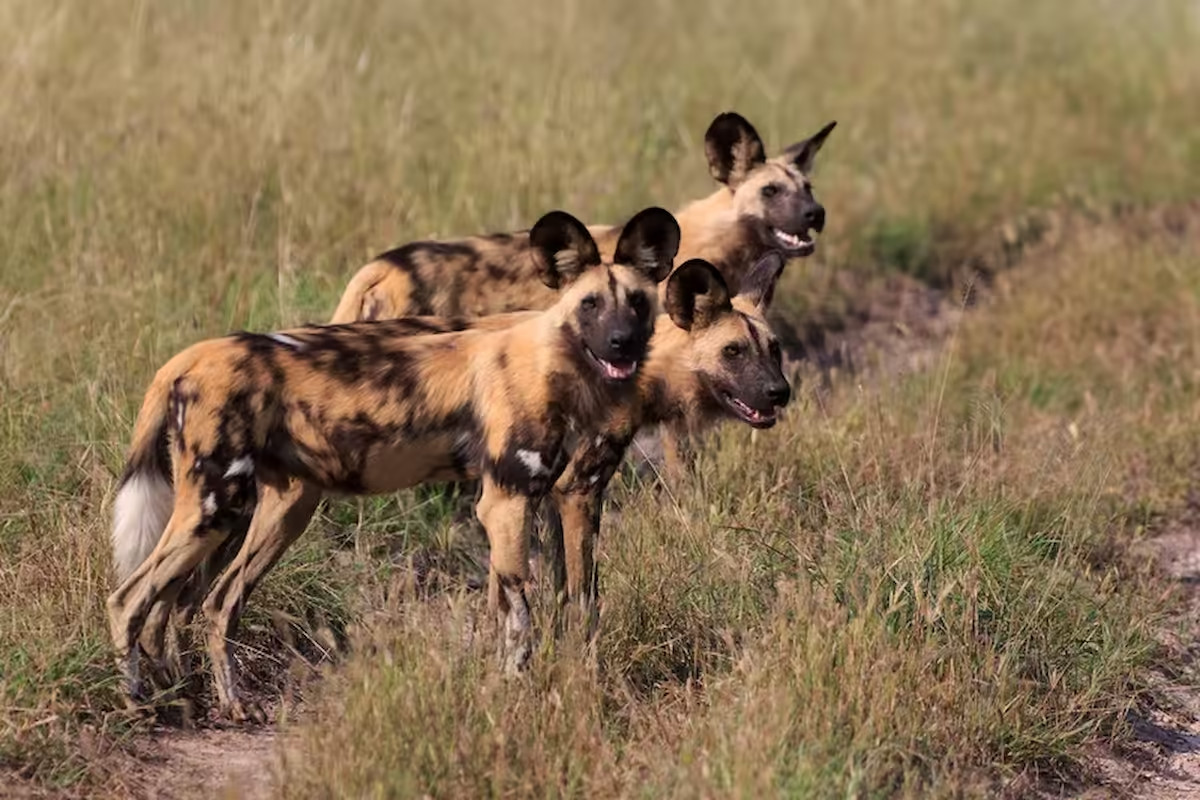
African wild dog
The African wild dog is one of the Okavango's particularly important conservation species. UNESCO specifically identifies African wild dog among the globally endangered large mammals supported by the Delta.
Wild dogs are highly mobile and their sightings are never guaranteed, but encountering a pack can be one of the most memorable experiences of a Botswana safari.
Cheetah
Cheetahs also occur within the Delta ecosystem. They are generally more dependent on open habitats than leopards, making floodplains and grassland areas particularly interesting when conditions are suitable.
Hippo
Hippos are strongly associated with the Delta's permanent waterways. They spend much of the day in water and become particularly impressive when encountered from boats, where travelers can observe them from a different perspective than during a conventional game drive.
Red lechwe
The red lechwe is one of the species that gives the Okavango its distinctive wetland character. These antelope are adapted to living around water and can move through shallow flooded areas with remarkable ease.
Other wildlife
Depending on location and season, an Okavango safari can also produce sightings of:
- Giraffe
- Zebra
- Impala
- Kudu
- Waterbuck
- Reedbuck
- Tsessebe
- Wildebeest
- Sable
- Roan antelope
- Steenbok
- Duiker
- Crocodile
- Serval
- Caracal
- Genet
- Rhinoceros
Botswana Tourism specifically lists many of these species among the Delta's wildlife.
Birdwatching in the Okavango Delta
The Okavango is not only a major destination for big-game safari. It is also one of southern Africa's important birding landscapes.
UNESCO records 482 bird species in the World Heritage property and identifies the Delta as an Important Bird Area. The wetland supports globally threatened species as well as large numbers of waterbirds.
Depending on the habitat and season, birders may encounter:
- African fish eagle
- Wattled crane
- Southern ground hornbill
- Slaty egret
- African skimmer
- Herons
- Egrets
- Kingfishers
- Storks
- Bee-eaters
- Jacanas
- Pelicans
- Vultures
- Various ducks and other waterbirds
The waterways make birdwatching particularly rewarding because many species can be observed around channels, lagoons and shallow floodplains.
The best safari activities in the Okavango Delta
One of the biggest advantages of the Okavango is that safari does not have to mean sitting in a vehicle all day. The environment allows travelers to experience the wilderness from several different perspectives.
Mokoro safari
A mokoro is a traditional canoe used to navigate the Delta's shallow waterways. The boat is propelled by a poler standing at the rear and pushing against the bottom with a long pole. Modern conservation practices mean many mokoros are now constructed from fiberglass rather than being carved from large trees.
The experience is intentionally slow and quiet. Instead of driving toward wildlife, you move through the landscape at water level, surrounded by reeds, papyrus, lilies and channels.
A mokoro excursion is especially valuable for:
- observing aquatic habitats
- photography
- birdwatching
- experiencing the Delta's waterways
- seeing smaller wildlife
- understanding the ecosystem from the water
It is important to understand that a mokoro is not primarily a big-game viewing vehicle. Its greatest strength is the intimate experience of the wetland.
Boat safaris
Where deeper channels are available, motorboats provide another way to explore the Delta. Boat trips can be excellent for:
- hippos
- crocodiles
- waterbirds
- elephants near waterways
- photographic landscapes
- sunset experiences
Boat safaris also allow travelers to cover waterways that are unsuitable for a traditional mokoro.
Game drives
Game drives remain central to the Okavango safari. Depending on the concession or reserve, drives can explore dry woodland, floodplains, islands and seasonal grasslands.
Game drives are particularly important for finding terrestrial predators such as:
- Lion
- Leopard
- Cheetah
- African wild dog
- Hyena
The quality of the experience depends heavily on the particular area, season and guide.
Walking safaris
Walking can reveal an entirely different side of the Delta. On foot, the objective is not simply to find the largest animal. The guide may focus on:
- animal tracks
- dung and spoor
- plants
- insects
- birds
- smaller mammals
- animal behavior
- the relationship between water and vegetation
Walking activities must be conducted under appropriate professional guidance because the Okavango is genuine Big Five and dangerous-wildlife habitat.
Community-led walking experiences are also developing in parts of the Delta. A 2026 Botswana government report, for example, documented a long-distance walking initiative involving indigenous community members in the NG32 concession.
Scenic flights
Because the Okavango is enormous and difficult to appreciate from ground level alone, a scenic flight can provide an extraordinary perspective. From above, travelers can see:
- winding channels
- isolated islands
- elephants moving through floodplains
- wildlife trails
- lagoons
- seasonal water patterns
- the contrast between wetland and Kalahari woodland
For a first visit, a scenic flight can also help explain why the Delta is better understood as a vast interconnected ecosystem rather than simply a collection of safari camps.
The main safari areas within the Okavango
The Okavango should not be treated as one uniform safari area. Different sections have different landscapes, access arrangements, water conditions and safari styles.
Moremi Game Reserve
Moremi is one of the most important protected areas within the greater Okavango ecosystem.
UNESCO states that approximately 40% of the World Heritage property is protected within Moremi Game Reserve, while the rest includes Wildlife Management Areas and other areas managed through community or private tourism arrangements.
Moremi is particularly useful for travelers who want a combination of game drives, diverse landscapes, wetland scenery, predator viewing and relatively accessible safari experiences.
Because Moremi is one of the most visited parts of the Delta, responsible tourism and visitor management are increasingly important.
Private concessions
Private concessions provide a different style of Okavango safari. Many operate with fewer vehicles and more exclusive accommodation, allowing camps to offer experiences that may not be available in the same form in public-access areas.
Depending on the specific concession and camp, activities may include:
- day and night game drives
- mokoro excursions
- boating
- guided walking
- fishing
- specialist photographic experiences
Activities are not identical across every concession, so a safari should be designed around the actual camp and area rather than simply marketed as an Okavango experience.
Community wildlife areas
Community involvement is an important part of the Delta's conservation model. The World Heritage property includes Wildlife Management Areas and other land managed through community trusts and private tourism concession-holders.
Botswana's Community-Based Natural Resource Management system is designed to give communities a role in managing wildlife and generating economic benefits from natural resources.
One example is the Okavango Kopano Mokoro Community Trust, which operates in the NG32 area and uses mokoro tourism as part of its community-based tourism model. Government reporting states that the trust has created employment and supported community projects through tourism revenues.
This matters because the Delta is not an uninhabited wilderness. People live around and alongside the ecosystem, and long-term conservation depends partly on ensuring that local communities benefit from wildlife and tourism.
When is the best time to visit the Okavango Delta?
There is no single month that is objectively best for everyone. The right time depends on whether your priority is:
- high flood levels
- water-based activities
- predator sightings
- general wildlife concentration
- birding
- lower-season travel
- specific photographic conditions
June to August: high water and dry season
This is one of the most iconic periods for the Okavango. The Delta's flood arrives during Botswana's dry season, producing the extraordinary contrast between surrounding dry landscapes and the wetland. UNESCO identifies June/July as the period when the annual flood tide becomes a critical ecological force in the Delta.
This period is particularly attractive for travelers who want classic Okavango scenery, strong water-based experiences, cool and dry conditions, excellent wildlife viewing and photography. Nights can be cold, so warm layers are important.
September to October: driest conditions
As the dry season progresses, many water sources outside the permanent channels become increasingly limited. Wildlife may concentrate more strongly around reliable water and productive areas.
This can produce excellent game viewing, although conditions are hotter than during the June to August period. For travelers primarily interested in terrestrial wildlife and predator activity, this can be an excellent period.
November to March: green season
The summer rains transform the Delta and surrounding landscapes. Temperatures rise and afternoon thunderstorms become more common. The landscape becomes greener, vegetation changes and many animals enter important breeding periods.
This season can be particularly rewarding for birdwatching, photography, dramatic skies, newborn animals, green landscapes and travelers who prefer fewer visitors.
Water levels in particular areas should not be assumed solely from the month, because the Delta's flood pulse comes from upstream rather than simply from local rainfall.
April to May: transition season
April and May form an interesting transition. The landscape begins moving from the rainy-season conditions toward the dry season, while the incoming flood gradually becomes increasingly important.
This period can offer a combination of greener scenery and improving wildlife conditions.
Is the Okavango Delta good for first-time safari travelers?
Yes - but it depends on what kind of safari the traveler expects.
For someone whose dream is to experience Africa through waterways, wilderness and a relatively exclusive safari environment, the Okavango is one of the strongest choices available.
However, it is not necessarily the simplest safari destination. Travel in the Delta often involves:
- small aircraft transfers
- remote camps
- bush airstrips
- changing water conditions
- higher accommodation costs
- multiple activity types
- limited road infrastructure in some areas
For a first safari, travelers who want a more conventional road-based itinerary may find destinations such as Kruger, Masai Mara or Serengeti easier. Travelers looking for an immersive luxury wilderness experience may prefer the Okavango.
How many nights do you need in the Okavango Delta?
2 nights
Two nights can work if the Delta is one component of a longer Botswana itinerary. It gives travelers enough time to experience camp life and participate in several activities, but the stay is short.
3 nights
Three nights is a much better minimum for most travelers. It provides enough time to experience several combinations of game drives, mokoro, boat safari, walking and wildlife viewing.
4-5 nights
Four or five nights are ideal when the Okavango is a major focus of the trip. A longer stay also makes it possible to combine different environments or concessions, reducing the risk of experiencing the Delta through only one narrow ecological setting.
Okavango Delta safari cost
The Okavango is generally positioned toward the premium and luxury end of African safari travel. That is not simply because of luxury accommodation. Operating a safari in the Delta can involve:
- remote air access
- aircraft transfers
- small camps
- specialist guides
- limited infrastructure
- conservation and concession costs
- logistics in a difficult wetland environment
Some camps are deliberately small and designed around low-impact tourism.
Therefore, comparing an Okavango safari directly with a conventional road safari by nightly accommodation price alone can be misleading. A lower-priced itinerary may provide a completely different safari model from an exclusive private-concession experience.
Why are Okavango safaris so expensive?
The geography is one of the biggest reasons. There are no extensive paved roads connecting every safari camp deep inside the Delta.
Instead, many travelers reach remote camps by light aircraft from Maun or from another safari area.
UNESCO notes that tourism in the inner Delta is limited to small temporary tented camps accessed by air, with facilities monitored for environmental compliance.
The price therefore reflects not only the room but also the logistics required to operate responsibly in a remote wetland.
Getting to the Okavango Delta
For international travelers, Maun is the main gateway for many Okavango safaris. From Maun, travelers can connect to remote camps using light aircraft. The exact routing depends on the camp or concession.
A typical itinerary may therefore look like: international arrival → Maun → light aircraft → Okavango camp → safari activities.
Travelers combining several Botswana destinations may fly between safari camps rather than repeatedly returning to Maun. This is one reason Botswana works particularly well as a fly-in safari destination.
What should you pack for an Okavango safari?
Pack for both safari and changing temperatures.
Clothing
- Lightweight neutral-colored clothing
- Long-sleeved shirts
- Lightweight trousers
- Warm fleece or jacket
- Comfortable walking shoes
- Hat
- Sunglasses
- Light rain jacket during the wetter season
Useful safari equipment
- Binoculars
- Camera
- Spare batteries
- Power bank
- Headlamp
- Sunscreen
- Insect repellent
- Reusable water bottle
For early-morning drives, do not underestimate the cold. Even when daytime temperatures become warm, early-morning game drives can be surprisingly cold during the dry winter months.
Okavango Delta vs Moremi Game Reserve
The two are closely connected but should not be treated as interchangeable terms. The Okavango Delta is the much larger wetland ecosystem. Moremi Game Reserve is a protected area within that broader ecosystem.
UNESCO explicitly identifies Moremi as covering around 40% of the World Heritage property. In practical terms, the Okavango Delta is the ecosystem, while Moremi is a protected area within it.
A safari marketed as an Okavango Delta safari may therefore involve Moremi, a private concession, a community area or a combination of these.
Okavango Delta vs Chobe
The Okavango and Chobe provide very different safari experiences. The Okavango Delta is about:
- wetlands
- channels
- islands
- mokoro
- boating
- diverse habitats
- luxury fly-in camps
Chobe is particularly famous for its large elephant concentrations and river-based wildlife viewing.
Combining the two can create a strong northern Botswana itinerary because travelers experience two distinct ecosystems rather than repeating the same safari environment.
Okavango Delta vs Serengeti
The Serengeti is a classic open-savannah safari destination, while the Okavango is defined by water and wetland ecology.
Choose the Serengeti if your priority is:
- enormous open plains
- the Great Migration
- classic savannah scenery
- large-scale predator-prey interactions
Choose the Okavango if your priority is:
- water-based safari
- mokoro
- remote luxury camps
- walking
- diverse wetland habitats
- intimate wilderness experiences
For travelers with enough time and budget, they can complement rather than replace each other.
Okavango Delta conservation
The Okavango's greatest strength is also one of its greatest vulnerabilities: its ecology depends on a functioning water system extending far beyond Botswana.
The Delta receives its water through an international river system, meaning upstream activities in Angola and Namibia can potentially affect downstream water availability. UNESCO identifies threats including:
- tourism pressure
- pollution
- water use
- human-elephant conflict
- wildfires
- invasive species
The current Okavango Delta Management Plan 2021-2028 is being implemented with increased attention to coordination, stakeholder engagement and community-based conservation.
Climate change is also increasingly important. Botswana government reporting has highlighted concerns about climate change, water resources and the challenge of maintaining coexistence between wildlife and communities.
Responsible tourism in the Okavango
A responsible Okavango safari should do more than minimize plastic waste. Travelers should consider whether their safari:
- works with licensed operators
- respects wildlife distances
- follows guide instructions
- supports local employment
- uses community-based tourism where appropriate
- avoids unnecessary disturbance
- minimizes waste and water use
- operates within the area's environmental regulations
The Delta's conservation model depends on tourism generating enough value to make protecting wildlife and habitat worthwhile for both national and local stakeholders.
Who should choose an Okavango Delta safari?
The Okavango is especially suitable for travelers who want:
Luxury travelers
Remote camps, small-scale accommodation and fly-in logistics make the Delta one of Africa's classic luxury safari destinations.
Honeymooners
The combination of private camps, water landscapes, secluded dinners and wilderness activities makes the Delta particularly attractive for romantic journeys.
Photographers
The combination of wildlife, reflections, waterways, dramatic skies and aerial perspectives creates exceptional photographic opportunities.
Experienced safari travelers
Travelers who have already experienced conventional game drives often appreciate the different rhythm of a Delta safari.
Families
Families can enjoy the Delta, but the best camp depends on children's ages and the camp's minimum-age rules. Families should select accommodation and activities specifically designed for younger travelers rather than assuming every luxury camp is family-friendly.
Suggested Okavango Delta safari itineraries
3-Day Okavango Delta safari
- Day 1: Maun → Okavango Delta camp
- Day 2: Morning game drive + mokoro or boating experience
- Day 3: Morning safari → flight onward
Best for travelers incorporating the Delta into a larger Botswana trip.
4-Day Okavango Delta safari
- Day 1: Arrive in Maun and fly to the Delta
- Day 2: Morning and afternoon safari activities
- Day 3: Game drive + water-based experience
- Day 4: Final morning activity and onward flight
A strong introduction for first-time visitors.
5-Day Okavango and Moremi safari
- Day 1: Maun → Okavango
- Day 2: Delta game viewing
- Day 3: Mokoro/boat experience + wildlife viewing
- Day 4: Transfer toward Moremi
- Day 5: Moremi game drive and onward travel
This provides greater landscape diversity.
7-Day northern Botswana safari
A longer itinerary can combine: Okavango Delta → Moremi → Khwai → Savuti/Chobe.
This works particularly well for travelers who want several ecosystems rather than spending the entire trip in one camp.
Suggested internal links
Chobe National Park > Serengeti National Park > Kruger National Park > Masai Mara National Reserve > Africa Safari Packages.
Okavango Delta FAQs
What is a mokoro safari like?
A silent poled canoe gliding reed channels past hippos and elephants - no engine, no rush, often the trip highlight.
Land or water camp?
Both if budget allows: water camps for mokoro and walks, land camps for predators and night drives.
When is the best time to visit Okavango Delta?
Flood peaks June to August (mokoro prime time); game viewing strong May to October.
What pairs well with Okavango Delta?
Combine water camps with Moremi/Khwai predator country.
How do internal flights and luggage limits work?
Bush flights allow 15 to 20kg in soft duffels; lodges store hard cases free. We route connections with realistic margins and meet you at every airstrip - missed-connection cover is built into fly-in trips.
Is this trip private?
Yes - every itinerary here runs with your own vehicle and guide. No Mixed-group compromises unless you ask for a join-in price.
How fit do we need to be?
Game-drive safaris need no fitness. Trekking trips state their grade honestly - ask for the training notes.
What is NOT included that surprises first-timers?
International flights, visas, travel insurance (required), premium drinks, the balloon flight where offered, and tips. Our quotes line-item park fees and permits so the total you compare is the total you pay.
What happens if it rains?
Game drives run rain or shine - vehicles have roofs and ponchos, animals remain active, and green-season light is superb for photography. Only true downpours pause activity, and camps flex schedules around them.
What insurance do we need?
Comprehensive travel insurance is required, including medical evacuation (AMREF/Flying Doctors cover, about 30 dollars, is recommended for remote circuits). Bring policy details - camps and operators ask for them.
Is the Okavango Delta a national park?
No. The Okavango Delta is a wetland ecosystem, not a national park.
The wider Delta contains different forms of protected and managed land, including Moremi Game Reserve, Wildlife Management Areas and tourism concessions. UNESCO describes the World Heritage property as a mosaic of protected lands with different management arrangements.
This distinction matters when booking a safari because two camps described as being in the Okavango Delta can offer very different access, activities and wildlife experiences depending on where they are located.
Why does the Okavango flood during the dry season?
The main floodwaters originate from rainfall in the Angolan highlands.
That water travels downstream through the Okavango system and eventually reaches Botswana during the country's dry season. This creates the Delta's famous seasonal reversal: the surrounding landscape is becoming increasingly dry just as the wetland receives a major influx of water.
This timing is fundamental to the Delta's ecology. Plants and animals have adapted their behavior and biological cycles to the flood pulse, which helps explain why the Okavango can support such a rich ecosystem in an otherwise arid region.
Is the Okavango Delta flooded all year?
Not every part of the Delta is flooded all year. Some channels, lagoons and swamps retain water permanently, while other areas flood seasonally and then dry out.
The extent of flooding also changes from year to year.
This creates the Delta's constantly changing mosaic of water and dry land. It is also why the location of wildlife can change considerably between seasons.
Can you see the Big Five in the Okavango Delta?
The species commonly referred to as Africa's Big Five - lion, leopard, elephant, buffalo and rhinoceros - occur within the Okavango ecosystem.
However, seeing all five on one safari is never guaranteed.
Elephant, buffalo and lion are generally more straightforward possibilities in suitable areas. Leopard and rhinoceros can require more time, specific locations and favorable conditions.
A good safari should therefore focus on the quality of the ecosystem and the overall wildlife experience rather than promising a fixed checklist.
Is the Okavango Delta good for wildlife viewing?
Yes, but wildlife viewing is seasonal and location-dependent.
During dry periods, animals may concentrate around reliable water and productive areas. At the same time, some floodplain habitats can become less accessible to conventional vehicles as water levels rise.
The important point is that high water does not automatically mean better land-based game viewing everywhere.
A strong itinerary combines different activities and, where appropriate, different areas of the Delta so travelers can experience both wetland and dryland habitats.
Is a mokoro safe?
Mokoro excursions are a standard tourism activity in the Okavango Delta, but travelers are still entering genuine wildlife habitat.
Experienced local polers and guides manage the activity and determine where and how the canoe is used. A mokoro is particularly suited to shallow water and quiet exploration, but it should not be thought of as an armored wildlife vehicle.
Travelers should follow their guide's instructions at all times and avoid sudden movements or attempts to approach wildlife independently.
Can you go on a walking safari in the Okavango?
Yes, walking experiences are available in some areas, particularly certain private concessions and community-based settings.
Walking is very different from a game drive because the focus extends beyond large animals to tracks, plants, insects, sounds and subtle signs of wildlife.
Because dangerous animals are present, walking must be conducted under qualified professional guidance and according to the rules of the particular concession.
Is the Okavango Delta suitable for a honeymoon?
Yes.
The Delta combines remote wilderness with small-scale camps, water-based activities, private dining and exceptional landscapes.
For honeymooners, the attraction is less about ticking off a list of animals and more about having a secluded safari experience in an environment that feels genuinely removed from everyday life.
A honeymoon itinerary can combine the Delta with another Botswana destination or with Victoria Falls, depending on available time.
How long should I spend in the Okavango Delta?
For most travelers, three nights is a useful minimum, while four or more nights allow a deeper experience.
If the Delta is part of a larger Botswana itinerary, two or three nights may be sufficient. If the Delta is the main purpose of the journey, four to five nights can be worthwhile, particularly when split between different environments or concessions.
The ideal duration depends on budget, travel pace and whether you want to combine the Delta with Moremi, Chobe, Savuti or another destination.
Should I visit the Okavango during high water or the dry season?
These are not necessarily competing choices because the famous high-water period occurs during Botswana's dry season.
If your priority is the classic flooded Okavango experience, the dry-season flood period is particularly attractive. If your priority is intense terrestrial wildlife viewing around shrinking water sources, the later dry season can also be excellent.
The best choice depends on whether your priority is water, wildlife concentration, temperature, photography or a combination of all four.
Is the Okavango Delta expensive?
It can be expensive, particularly when staying at remote luxury camps.
The cost reflects more than accommodation. Remote camps may require light-aircraft transfers, specialist staff, complex supply chains and low-density tourism infrastructure.
However, Botswana also has different safari styles and accommodation categories, so an Okavango safari does not automatically mean one fixed price level.
The itinerary should be designed around the traveler's budget and priorities rather than choosing a camp solely by nightly rate.
Do I need a private safari in the Okavango?
Not necessarily. The Delta has both private and more accessible safari options.
However, private concessions can offer a greater sense of exclusivity and may allow a broader range of activities depending on the specific concession.
For travelers celebrating a honeymoon, anniversary or special occasion, private-concession accommodation can be particularly attractive.
Can children go on an Okavango safari?
Yes, but the suitability of a particular camp depends heavily on the child's age and the camp's rules.
Some remote camps have minimum-age restrictions because activities may include walking or operate in areas with dangerous wildlife.
Families should therefore choose the camp before finalizing the itinerary, rather than assuming every Okavango property accepts children of all ages.
A family-focused itinerary may also use more conventional game-drive areas and accommodations where activities can be adapted to younger travelers.
What makes the Okavango different from other African safari destinations?
Its defining feature is the relationship between water and wildlife. The Okavango combines:
- an inland delta
- seasonal flooding
- permanent waterways
- dry Kalahari landscapes
- islands
- floodplains
- large mammals
- predators
- exceptional birdlife
- water-based safari
- walking experiences
- remote fly-in camps
Very few safari destinations combine all of these elements at this scale.
Put Okavango Delta in the right place
Season, zone and camp selection by a specialist.