
Uganda | Park guide
Queen Elizabeth National Park
Savanna lions, Kazinga Channel hippos and Ishasha's tree-climbing lions.
Queen Elizabeth National Park is Uganda's classic all-round wildlife destination. Covering approximately 1,978 km², it combines savanna plains, wetlands, lakes, crater landscapes, forests and the famous Kazinga Channel. UWA describes it as Uganda's most popular and biodiverse safari destination, with more than 95 mammal species and over 600 bird species.
What makes Queen Elizabeth particularly valuable for a safari itinerary is its diversity. You can drive across open plains looking for lions and Uganda kob, search woodland and grassland edges for elephants and buffalo, cruise the Kazinga Channel among hippos and waterbirds, explore Kyambura Gorge for chimpanzees and travel south toward Ishasha in search of the park's famous tree-climbing lions.
It is therefore not a destination built around one species.
It is a destination built around variety.
Safaris visiting Queen Elizabeth National Park
Where is Queen Elizabeth National Park?
Queen Elizabeth National Park lies in southwestern Uganda.
It is positioned between Lake Edward and Lake George, with the Kazinga Channel connecting the two lakes.
The park also sits against some of western Uganda's most dramatic landscapes, including views toward the Rwenzori Mountains and volcanic crater country.
UWA places the park approximately 410 km west of Kampala, with the drive taking at least seven to eight hours depending on conditions and route. Flights can also reach nearby airstrips including Kasese, Mweya and Kihihi for the Ishasha side.
The landscape of Queen Elizabeth
Queen Elizabeth is unusually varied for a relatively compact safari area.
Its landscapes include:
- open savanna
- woodland
- wetlands
- crater lakes
- lakeshores
- forests
- river and channel habitats
- volcanic landscapes
UWA's park information highlights the Kasenyi plains, Ishasha grasslands, Kazinga Channel, crater country and the Rwenzori backdrop as some of the defining landscapes of the park.
This diversity is one reason Queen Elizabeth can support such a broad range of mammals and birds.
Wildlife in Queen Elizabeth National Park
Queen Elizabeth supports more than 95 mammal species.
Common safari highlights include:
- elephants
- buffaloes
- hippos
- lions
- leopards
- Uganda kob
- warthogs
- waterbucks
- various antelope
- chimpanzees in Kyambura Gorge
The park is also particularly important for birders, with UWA listing more than 600 bird species.
The Kasenyi plains
The Kasenyi plains are among the most productive areas for conventional game drives.
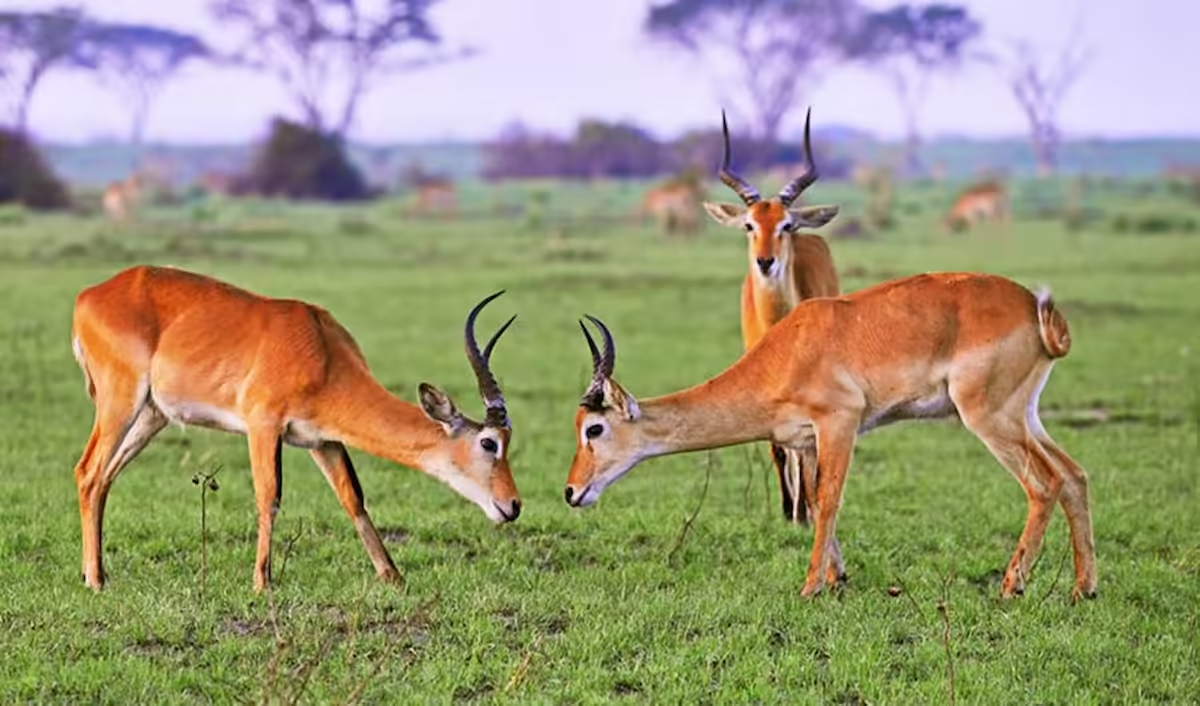
The open grasslands support large numbers of Uganda kob, which in turn provide important prey for lions.
This is one of the places where the safari experience feels closest to the classic East African savanna: open grassland, grazing herbivores, predators moving through the landscape and broad views.
UWA identifies the Kasenyi plains as one of the areas where visitors have good opportunities to search for lions.
Ishasha and the tree-climbing lions
The southern Ishasha sector is one of Queen Elizabeth's most famous attractions.
Its tree-climbing lions have become internationally recognized, but their population is facing conservation pressure.
In 2026, UWA and the Wildlife Conservation Society launched an Ishasha collaborative conservation programme specifically addressing the area's lion population, wider ecosystem management and community engagement. UWA reported that only three known adult lions remained in Ishasha at the time of the announcement.
This is an important distinction for tourism content.
Ishasha should not be marketed as a place where every visitor will automatically see lions hanging from fig trees.
The tree-climbing behaviour is famous, but sightings are still wildlife sightings.
The correct expectation is that Ishasha offers an opportunity to search for these distinctive lions within a remarkable savanna landscape.
Why do Ishasha lions climb trees?
The exact reason can vary.
Tree-climbing may provide relief from heat, allow lions to avoid insects at ground level, provide a vantage point over the surrounding landscape or simply reflect individual and local behavioural patterns.
The important point for travelers is that the behaviour is not guaranteed.
When the lions are resting in trees, the sight can be spectacular.
When they are on the ground, they are still worth seeing.
Kazinga Channel
The Kazinga Channel is one of the defining features of Queen Elizabeth National Park.
The channel connects Lake George and Lake Edward and is renowned for its concentration of hippos and other wildlife.
UWA describes it as having perhaps the highest concentration of hippos in Uganda, while its park materials emphasize the channel as one of the destination's major wildlife attractions.
A boat safari on the Kazinga Channel provides a completely different perspective from a game drive.
Instead of looking across grasslands, travelers move slowly along the water, often seeing:
- hippos
- crocodiles
- buffalo
- elephants near the shoreline
- waterbirds
- other animals coming to drink
The shoreline can be extraordinarily productive for photography.
Why the Kazinga Channel boat safari is worth doing
A boat safari complements rather than replaces a game drive.
From the water, animals can often be viewed at eye level, particularly hippos and waterbirds.
The channel also concentrates wildlife around a relatively narrow aquatic environment, making it easier to observe behaviour and interactions than in open savanna.
For first-time visitors to Queen Elizabeth, the combination of game drive + Kazinga Channel boat safari is one of the strongest ways to experience the park.
Kyambura Gorge and chimpanzees
Kyambura Gorge provides a very different experience.
The gorge lies in the Queen Elizabeth ecosystem and supports habituated chimpanzees available for tracking.
UWA's chimpanzee management guidelines identify Kyambura as one of the designated chimpanzee tracking locations within the Queen Elizabeth Conservation Area.
Chimpanzee tracking begins at specific times, with UWA's current guidelines listing morning tracking from 8:00 am and afternoon tracking from 2:00 pm. Viewing for standard chimpanzee tracking is limited to a maximum of one hour, while habituation experiences can allow longer observation under the relevant programme.
The gorge experience is physically different from a savanna game drive.
You descend into a forested landscape where chimpanzees can move through dense vegetation and trees.
Seeing them requires patience.
Queen Elizabeth for birdwatching
With more than 600 recorded bird species, Queen Elizabeth is one of Uganda's most important birding destinations.
Its combination of lakes, wetlands, savanna, woodland and forest creates a remarkable variety of habitats.
Birding can therefore be incorporated into a conventional safari rather than requiring a completely separate itinerary.
The Kazinga Channel is particularly useful for waterbirds, while savanna and woodland areas offer another group of species.
Crater lakes and scenic drives
Queen Elizabeth is not only about wildlife.
The volcanic crater landscapes east of the main park provide scenic opportunities and a geological dimension to the safari.
UWA identifies the Katwe Explosion Craters as the highest point within the park at approximately 1,350 metres, while the lowest point is around 910 metres along Lake Edward.
Crater drives can therefore be an excellent complement to game viewing, particularly for travelers interested in landscapes and photography.
Culture around Queen Elizabeth
The park's surroundings are culturally significant as well as ecologically important.
UWA notes opportunities for visitors to interact with local communities through storytelling, dance, music and other experiences.
A well-designed safari should therefore not treat Queen Elizabeth simply as a wildlife enclosure.
The protected area exists within a living landscape where conservation, tourism, fishing, agriculture and community livelihoods interact.
Conservation and human-wildlife conflict
Queen Elizabeth's conservation story also involves significant challenges.
Communities live around the protected area, and wildlife occasionally moves beyond park boundaries.
UWA has identified human-wildlife conflict as an important issue and has used measures including electric fencing to reduce crop damage and other conflicts. UWA reported that electric fencing had been constructed around sections of Queen Elizabeth and other protected areas as part of these efforts.
This is important context for travelers.
The continued existence of Queen Elizabeth's wildlife depends not only on what happens inside the park, but also on whether surrounding communities see conservation as compatible with their livelihoods.
Best time to visit Queen Elizabeth National Park
Queen Elizabeth can be visited throughout the year.
Wildlife remains present year-round, but seasonal conditions affect roads, vegetation, wildlife distribution and photographic conditions.
During drier periods, animals may concentrate more around available water and visibility can improve in some areas.
During wetter periods, vegetation becomes greener and bird activity can be excellent, but some roads and tracks can become more challenging.
There is therefore no single "best month" for every traveler.
A photographer looking for lush scenery may prefer a different period from someone prioritizing easier game-drive conditions.
How long should you spend in Queen Elizabeth?
2 nights
Enough for a focused safari including:
- game drives
- Kazinga Channel boat safari
3 nights
A better option if you want:
- game drives
- Kazinga Channel
- Kyambura chimpanzee tracking
- crater landscapes
3–4 nights with Ishasha
Recommended for travelers who specifically want to explore the southern sector and search for the tree-climbing lions.
How to combine Queen Elizabeth with Bwindi
This is one of western Uganda's strongest safari combinations.
Route 1: Queen Elizabeth → Ishasha → Bwindi
This route is particularly logical for travelers staying in Buhoma.
It allows you to move from savanna wildlife to Ishasha and then into the mountain forest.
Route 2: Bwindi → Queen Elizabeth
This can also work depending on the direction of the wider itinerary.
The key is to avoid unnecessary backtracking by choosing the correct Bwindi sector and accommodation.
For a traveler wanting a strong introduction to Uganda's wildlife and primates, one of the most compelling combinations is:
Kibale Forest → Queen Elizabeth → Ishasha → Bwindi
This progression moves from chimpanzee-rich rainforest to savanna wildlife, the Kazinga Channel and Ishasha, before finishing with mountain gorilla trekking in Bwindi.
It also creates a much stronger destination story than treating each park as an isolated stop.
Suggested Queen Elizabeth safari packages
3-Day Queen Elizabeth safari
- Day 1: Arrival and game drive
- Day 2: Morning game drive + Kazinga Channel boat safari
- Day 3: Departure
Ideal for travelers wanting a short classic Uganda safari.
4-Day Queen Elizabeth & Chimpanzee safari
- Day 1: Arrival
- Day 2: Game drive + Kazinga Channel
- Day 3: Kyambura chimpanzee tracking + crater area
- Day 4: Departure
Better for travelers interested in both wildlife and primates.
5-Day Queen Elizabeth, Ishasha & Bwindi
- Day 1: Queen Elizabeth
- Day 2: Game drive + Kazinga Channel
- Day 3: Ishasha wildlife viewing
- Day 4: Bwindi gorilla trekking
- Day 5: Departure
This is one of the strongest combinations for travelers wanting a compact but diverse Uganda safari.
Suggested internal links
Uganda Safari · Bwindi Gorilla Trekking · Kibale Chimpanzee Tracking · Uganda Wildlife Safaris · Bwindi Impenetrable Forest.
Queen Elizabeth National Park FAQs
Is Queen Elizabeth National Park worth visiting?
Yes, particularly for travelers who want variety.
Queen Elizabeth combines classic savanna wildlife, large concentrations of hippos, water-based safari, primate experiences, birding, crater landscapes and the famous Ishasha sector.
Its strength is not necessarily that it has the highest concentration of one particular species.
Its strength is that several different safari experiences can be combined in one protected landscape.
What animals can I see in Queen Elizabeth National Park?
The park contains more than 95 mammal species.
Common sightings include elephants, buffalo, hippos, Uganda kob and other antelope. Lions can be searched for in areas such as Kasenyi and Ishasha, while leopards are also present but are less predictable.
Chimpanzees are a separate specialist experience at Kyambura rather than an ordinary game-drive sighting.
Can I see the Big Five in Queen Elizabeth?
Queen Elizabeth has elephants, lions, leopards and buffalo.
It does not have a resident population of wild rhino within the park, so it should not be marketed as a traditional Big Five destination in the same way as parks where all five species occur.
The park's appeal is broader than a Big Five checklist.
Is the Kazinga Channel boat safari worth it?
Yes.
For many travelers, the boat safari becomes one of the highlights of Queen Elizabeth because it provides a completely different wildlife-viewing perspective.
Hippos are particularly prominent, and the shoreline can produce excellent opportunities for elephants, buffalo and waterbirds.
Are there crocodiles on the Kazinga Channel?
Yes. Crocodiles can be seen in the Queen Elizabeth aquatic ecosystem.
However, wildlife sightings are never guaranteed, and the exact number and location of animals varies.
Can I see tree-climbing lions in Queen Elizabeth?
Yes, but they should be treated as a wildlife possibility rather than a guaranteed sighting.
Ishasha is internationally famous for its tree-climbing lions, but UWA's recent conservation update highlights the serious pressure on the local lion population and the need for active conservation intervention.
This makes responsible tourism particularly important.
Is Ishasha worth visiting if I don't see tree-climbing lions?
Yes.
Ishasha is a beautiful southern savanna landscape with wildlife beyond the lions.
The value of visiting should not depend entirely on whether a lion happens to be resting in a fig tree on that particular day.
Can I track chimpanzees in Queen Elizabeth?
Yes.
Chimpanzee tracking is available in Kyambura Gorge, one of the designated chimpanzee tracking locations within the Queen Elizabeth Conservation Area.
The experience is different from Kibale because Kyambura is integrated into a broader savanna-and-forest safari rather than being primarily a chimpanzee destination.
Queen Elizabeth or Murchison Falls — which is better?
They offer different experiences.
Queen Elizabeth is particularly strong for Kazinga Channel, hippos, Ishasha, tree-climbing lion opportunities, Kyambura chimpanzees, crater landscapes and Rwenzori views.
Murchison Falls is particularly strong for the Nile, Murchison Falls itself, boat safari toward the falls, savanna wildlife and large landscapes.
For a first Uganda safari, the choice should depend on the route and the other parks included.
How many days do you need in Queen Elizabeth?
Two nights can provide a good introduction.
Three nights is better if you want to include chimpanzee tracking or a more relaxed combination of game drives and the Kazinga Channel.
If Ishasha is a priority, additional time or careful route planning is worthwhile.
Can Queen Elizabeth and Bwindi be combined?
Yes, and they make an excellent combination.
The journey through Ishasha can connect Queen Elizabeth with the Buhoma side of Bwindi, creating a natural progression from savanna to rainforest. UWA specifically identifies the Ishasha route as one of the approaches toward Buhoma.
Is Queen Elizabeth suitable for families?
Yes.
The combination of game drives, boat safari and varied landscapes can work very well for families.
The itinerary should simply be paced appropriately, especially when combining long road transfers with early-morning game drives.
Is Queen Elizabeth good for birdwatching?
Very much so.
With more than 600 bird species recorded, the park offers exceptional habitat diversity for birders.
A traveler interested in birds should tell the safari operator in advance so that the itinerary can be adjusted around birding opportunities rather than treating birdwatching as an incidental activity.
Can you visit Queen Elizabeth without going on a game drive?
Yes.
The Kazinga Channel boat safari, chimpanzee tracking, crater landscapes, birding and community experiences can all add depth to a visit.
Nevertheless, game drives remain one of the principal ways to experience the park's savanna wildlife.
What makes Queen Elizabeth different from other Uganda parks?
Its greatest strength is diversity.
It gives travelers the chance to experience open savanna, lakes, wetlands, forest, crater landscapes, primates and aquatic wildlife within one destination.
That makes it particularly useful as the central wildlife component of a western Uganda itinerary.
Put Queen Elizabeth National Park in the right place
Season, zone and camp selection by a specialist.