
Namibia | Park guide
Sossusvlei & Namib-Naukluft
300-metre red dunes, Deadvlei's white clay pan - Africa's great desert icons.
Sossusvlei is Namibia's most recognizable desert landscape: a vast basin of pale clay surrounded by enormous orange-red dunes in the heart of the Namib-Naukluft National Park. The destination is famous for the contrast between the towering dunes, white salt-and-clay pans, the blackened camel-thorn trees of Deadvli, and the extraordinary emptiness of the surrounding Namib Desert. Sossusvlei is not itself a national park; it is an iconic site within the much larger Namib-Naukluft National Park, Namibia's largest protected area at approximately 49,768 km².
The wider landscape is part of the Namib Sand Sea, a UNESCO World Heritage Site covering more than 3 million hectares. UNESCO describes it as the only coastal desert in the world containing extensive dune fields influenced by fog, with exceptional geological formations and highly specialized desert life.
A Sossusvlei safari is therefore very different from a conventional African wildlife safari. The attraction is not primarily large concentrations of animals. It is the combination of desert geology, enormous dunes, changing light, ancient river systems, adapted wildlife, photography, hiking, and the feeling of being surrounded by one of the world's most extreme landscapes.
Safaris visiting Sossusvlei & Namib-Naukluft
Why visit Sossusvlei?
Sossusvlei deserves a place on a Namibia safari itinerary because it offers an experience that is difficult to reproduce anywhere else in Africa.
The landscape changes dramatically throughout the day. At sunrise, the dunes produce long shadows and sharp contrasts. As the sun rises, the red and orange tones become stronger and the shadows retreat across the sand. By afternoon, the landscape becomes brighter and harsher, while sunset transforms the dunes again.
The attraction is also remarkably diverse within a relatively concentrated area. A visitor can combine Sossusvlei and Deadvli with Big Daddy, Dune 45, Sesriem Canyon, desert wildlife viewing, nature walks, photography, and spectacular night skies.
Namibia's Ministry of Environment identifies Sossusvlei, Dead Vli, Sossus Pan, Sesriem Canyon and the area's exceptionally high dunes among the principal attractions of Namib-Naukluft National Park.
Sossusvlei and the Namib-Naukluft National Park
Understanding the geography is important because Sossusvlei is often incorrectly described as if it were a separate national park.
Sossusvlei is a destination within Namib-Naukluft National Park.
The park was created through the amalgamation of earlier protected areas, including the Namib Desert Park and Naukluft Mountain Zebra Park, with the present Namib-Naukluft Park proclaimed in 1979. Its landscapes extend far beyond Sossusvlei, including desert dunes, gravel plains, mountains, inselbergs, ephemeral rivers and the Atlantic coastal environment.
The park covers approximately 49,768 km², making it one of the largest protected areas in Africa. The Ministry records wildlife including oryx, Hartmann's mountain zebra, springbok, giraffe, brown hyena, leopard and baboon, as well as 348 recorded bird species across the park.
For travelers, however, the Sesriem-Sossusvlei section is the part most closely associated with the classic red-dune experience.
The Namib Sand Sea: the geological setting
The extraordinary appearance of Sossusvlei makes more sense when the wider Namib Sand Sea is understood.
The UNESCO-listed Namib Sand Sea covers approximately 3,077,700 hectares, with a buffer zone of another 899,500 hectares. It contains extensive active dune fields, older semi-consolidated dunes, gravel plains, coastal flats, rocky formations, inselbergs and ephemeral rivers.
What makes the Namib particularly unusual is its relationship with fog.
Although the desert is extraordinarily dry, coastal fog provides an important source of moisture for specialized organisms. UNESCO identifies the Namib Sand Sea as the world's only coastal desert containing extensive dune fields influenced by fog and highlights the unusual adaptations of its endemic species.
This is why a Sossusvlei safari should not be presented simply as a trip to see big dunes. The dunes are part of a much larger geological and ecological system that has developed over immense periods of time.
Sossusvlei: where the Tsauchab River ends
The name Sossusvlei is associated with the terminal basin of the Tsauchab River.
The Tsauchab is an ephemeral river: it does not flow continuously to the Atlantic. Instead, water from rainfall in its catchment can travel through the river system before eventually reaching the desert sands.
At Sossusvlei, the surrounding dunes prevent the river from continuing toward the ocean. During exceptional flooding events, water can reach the pan, creating a temporary lake-like landscape.
Most of the time, however, Sossusvlei is dry.
The result is the pale clay-and-salt surface surrounded by immense dunes that has become one of Namibia's defining landscapes.
This distinction is important when explaining the destination: Sossusvlei is not a permanently flooded wetland. It is an ephemeral terminal pan in an extremely arid desert environment.
Sossusvlei vs Deadvli
One of the most common mistakes in online Sossusvlei information is treating Sossusvlei and Deadvli as the same place.
They are different pans within the same wider dune landscape.
Sossusvlei is the terminal pan associated with the Tsauchab River. In exceptionally wet periods, water can reach the pan, producing a striking contrast between blue water, pale clay and surrounding red dunes.
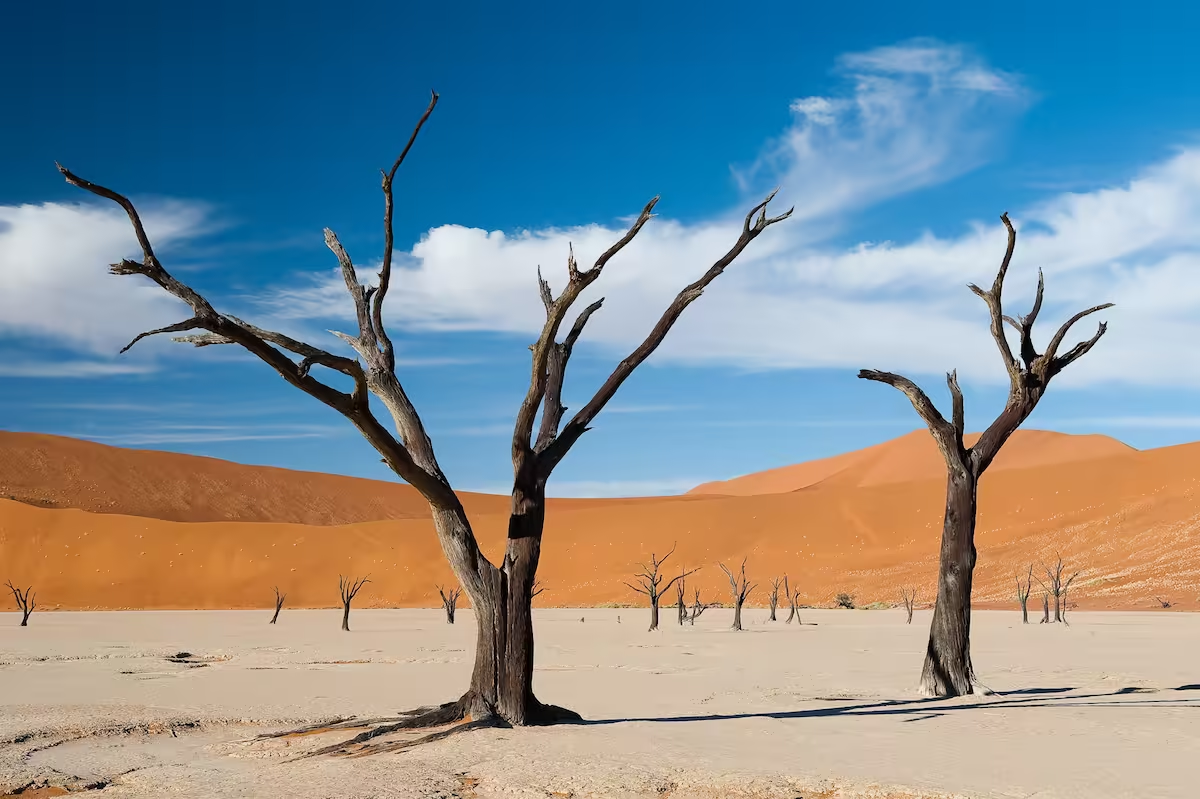
Deadvli is a separate, dry clay pan famous for its dark, dead camel-thorn trees standing against the white ground and orange dunes.
The trees grew when water from the Tsauchab reached the area. Shifting dunes eventually blocked the water supply, causing the trees to die. The exceptionally dry environment slowed decomposition, leaving their trunks standing for centuries.
The precise age attributed to the trees varies between sources, so it is better to describe them as centuries-old dead camel-thorn trees rather than presenting a questionable exact age as established fact.
This is also why Deadvli should not be described as a forest of petrified trees. The trees are not petrified; they are exceptionally well preserved by the extreme dryness.
Deadvli
Deadvli is arguably the most photographed landscape in Namibia.
The composition is remarkably simple: white clay pan, blackened camel-thorn trees, orange-red dunes and intense blue sky.
The absence of vegetation from most of the pan creates an almost surreal appearance.
The dead trees are especially vulnerable to careless visitor behavior. They should never be climbed, touched unnecessarily, broken, or used as props. The landscape is valuable precisely because its appearance has survived for centuries under extraordinarily dry conditions.
The walk from the parking area involves exposed sand and should not be underestimated, particularly during warmer parts of the day.
For photographers, the first hours after sunrise are particularly valuable because the low-angle light creates strong shadows across the pan and emphasizes the contrast between the trees and dunes.
Big Daddy dune
Big Daddy is one of the signature dunes in the Sossusvlei area and rises dramatically above the surrounding pans.
Climbing the dune is physically demanding. The sand shifts beneath the feet, meaning that walking a straight line up a steep dune face can be exhausting.
The reward is the changing perspective.
From higher on the dune, the visitor can see the extraordinary relationship between the orange sand sea, Deadvli and the surrounding desert landscape. The experience is less about simply reaching the highest point and more about understanding the scale of the landscape.
For travelers interested in photography, the dune provides elevated views that reveal patterns impossible to appreciate from ground level.
Dune 45
Dune 45 is another iconic landmark near Sesriem and is one of the most recognizable dunes in Namibia.
Its accessibility and distinctive shape have made it one of the most popular sunrise stops in the Sossusvlei area.
Climbing a dune such as Dune 45 is considerably harder than walking on firm ground because every step can sink into the sand. Travelers should carry water, protect themselves from the sun and avoid rushing the ascent.
The experience is particularly rewarding for visitors who want to physically experience the dunes rather than simply photograph them from the road.
Sesriem Canyon
Sossusvlei is not only about dunes.
At Sesriem, the Tsauchab River has cut a narrow canyon into the surrounding rock. Namibia Wildlife Resorts describes the canyon as approximately 1 km long, with sections descending roughly 30-40 metres. Pools can form at the bottom following good rains.
The canyon provides a useful contrast to the open dune landscape.
Instead of looking across a huge horizon, visitors descend into a narrow geological formation where the walls provide shade and reveal layers created by erosion.
Sesriem Canyon is therefore worth including even on a short Sossusvlei itinerary.
Wildlife around Sossusvlei
Sossusvlei is not the destination to choose if your primary goal is seeing large numbers of lions, elephants or buffalo.
The desert supports wildlife, but animals are distributed across a much harsher environment.
Species recorded within Namib-Naukluft Park include oryx, Hartmann's mountain zebra, springbok, giraffe, brown hyena, leopard and baboon, numerous desert-adapted smaller mammals and reptiles, and a wide variety of birds.
The Ministry of Environment records 348 bird species for the Namib-Naukluft Park.
The important point is that desert wildlife is often encountered differently from wildlife in wetter safari destinations.
Rather than large herds concentrated around permanent water, animals are adapted to move through enormous spaces, survive with limited surface water and exploit temporary resources.
Oryx: the icon of the Namib
The gemsbok, or oryx, is one of the animals most strongly associated with Namibia's desert landscapes.
Its ability to survive in arid environments makes it an excellent symbol of the Namib.
Seeing an oryx moving across an open gravel plain or between dunes can be one of the most memorable wildlife moments around Sossusvlei precisely because the animal appears to belong naturally to this harsh environment.
For travelers coming directly from Etosha, the difference is striking.
Etosha can offer concentrated wildlife around waterholes.
Sossusvlei demonstrates another side of Namibia: survival across an immense dry landscape.
Desert-adapted plants
The desert around Sossusvlei may initially appear lifeless, but specialized plants demonstrate how much biological activity exists beneath the apparent emptiness.
The camel-thorn tree is particularly important around ephemeral river systems.
The Ministry also records Welwitschia mirabilis, shepherd's tree, lichens and other desert vegetation within Namib-Naukluft Park.
The wider Namib Sand Sea is especially important for endemic organisms that have evolved to survive extreme aridity. UNESCO identifies unusual behavioral, physiological and morphological adaptations among its desert species.
This makes a guided desert walk valuable for travelers who want more than photographs. A knowledgeable guide can reveal tracks, insects, plants and other signs of life that are easy to miss from a vehicle.
Fog and life in the Namib Desert
The Namib is often described as one of the world's oldest deserts, but the important ecological story is not simply its age.
It is the way organisms survive in such a dry environment.
The Atlantic Ocean and atmospheric conditions along Namibia's coast generate fog that can penetrate parts of the desert. UNESCO identifies fog as the primary source of water within the Namib Sand Sea's specialized environment.
Certain insects, reptiles and other organisms have evolved highly specialized ways of obtaining and conserving moisture.
This makes the Namib an important destination for travelers interested in ecology and natural history, not just scenery.
Best things to do at Sossusvlei
Sunrise at Sossusvlei
Sunrise is one of the defining experiences.
The low morning sun creates long shadows across the dunes and reveals the sculpted shape of the sand.
It is also one of the best times for photography because the light is softer than during the middle of the day.
Explore Deadvli
Deadvli should be treated as a dedicated stop rather than a quick photo opportunity.
Allow time to walk across the pan, photograph the trees from different angles and appreciate the relationship between the white clay, dark trunks and surrounding dunes.
Climb a dune
Dune climbing provides a physical experience of the desert.
Dune 45 is a popular option, while Big Daddy offers a more demanding climb and dramatic elevated views.
Travelers should consider fitness, heat and sand conditions before attempting a long ascent.
Visit Sesriem Canyon
Sesriem Canyon can easily be incorporated into a Sossusvlei itinerary and provides a completely different landscape from the dunes.
Desert nature walks
A guided walk can reveal the smaller side of the Namib.
Tracks, insects, plants, reptiles and geological formations become much easier to understand with a knowledgeable guide.
Photography
Sossusvlei is one of Africa's strongest destinations for landscape photography.
The main subjects include dune ridges, Deadvli trees, desert shadows, Sesriem Canyon, desert wildlife, sunrise, sunset, stars and changing dune colors.
Stargazing
The isolation and low artificial-light environment around the Namib make the region particularly attractive for travelers interested in night skies.
Namib-Naukluft Park itself lists stargazing among its tourism activities.
A desert night can be almost as memorable as the daytime landscape.
Sossusvlei for photography
Sossusvlei rewards photographers because the landscape changes constantly with light.
At sunrise, the best subjects are long shadows, cooler tones, sharp dune contours and Deadvli compositions.
Mid-morning is best for stronger orange and red tones, detailed dune textures and wider landscape scenes.
Late afternoon is excellent for warm light, dramatic dune profiles and longer shadows.
Sunset is ideal for silhouettes, atmospheric landscapes and wide desert scenes.
A major advantage of staying close to Sesriem is the ability to organize the day around these changing conditions rather than treating Sossusvlei as a rushed excursion.
When is the best time to visit Sossusvlei?
Sossusvlei can be visited throughout the year, but the experience changes considerably between seasons.
May to October: dry season
The cooler dry months are generally the most comfortable period for exploring the dunes.
Days are usually clear, visibility is excellent and the dry landscape produces the classic Sossusvlei appearance.
Mornings can be surprisingly cold, however, so travelers should not pack only for daytime desert heat.
This is also a strong period for photography because clear skies and low humidity can produce excellent visibility.
November to April: warmer and wetter period
The warmer months can bring occasional rainfall.
Rain does not turn Sossusvlei into a permanently wet landscape. Instead, exceptional rainfall events can produce temporary water in parts of the drainage system.
The landscape can also become more dynamic after rain, while cloud formations can create dramatic photographic conditions.
The trade-off is higher daytime heat and less predictable weather.
Which season should you choose?
For a first-time Namibia itinerary focused on classic dunes, comfortable exploration and photography, the cooler dry season is usually the easiest recommendation.
For travelers who enjoy unusual weather, fewer conventional seasonal expectations and the possibility of seeing the desert respond to rainfall, the warmer months can offer something different.
How many days do you need in Sossusvlei?
1 night / 2 days
Suitable for travelers with limited time.
A short stay can include arrival at Sesriem, Sesriem Canyon, Elim Dune or a sunset activity on day 1, then an early Sossusvlei departure for Dune 45, Deadvli and Sossusvlei on day 2 before returning toward the next destination.
This works, but the schedule is relatively tight.
2 nights / 3 days
This is the recommended minimum for travelers who want to experience the area without rushing.
Day 1: arrive in the Sossusvlei region, settle into your lodge or campsite, visit Sesriem Canyon and enjoy the desert landscape around sunset.
Day 2: start early for Dune 45, Sossusvlei, Deadvli, Big Daddy and photography, with afternoon relaxation.
Day 3: enjoy a slower desert morning, a nature activity or a scenic drive before continuing toward Swakopmund, Walvis Bay or another Namibia destination.
3 nights / 4 days
Recommended for travelers who value photography, hiking and a slower pace.
This allows additional time for multiple sunrise photography sessions, dune climbing, Sesriem Canyon, desert walks, scenic drives, stargazing and lodge relaxation.
It is especially appropriate for honeymooners and photographers who do not want the destination reduced to a single early-morning excursion.
Where to stay for Sossusvlei
Accommodation strategy matters because the timing of the Sossusvlei visit is important.
Staying near Sesriem or inside the park can reduce the amount of driving required to reach the dunes.
Sesriem Campsite
Namibia Wildlife Resorts operates Sesriem Campsite near Sesriem Canyon.
The facility currently lists 44 campsites plus six overflow campsites, and its attractions include Sesriem Canyon, Sossusvlei and Elim Dune.
It is particularly suitable for self-drive travelers, budget-conscious visitors, camping enthusiasts and travelers building a Namibia road trip.
Sossus Dune Lodge
Sossus Dune Lodge is located inside Namib-Naukluft Park and offers 23 dune chalets and 2 honeymoon suites.
Its activities include guided sunrise excursions to Sossusvlei, afternoon nature drives and guided walks to Sesriem Canyon.
Its location inside the park is particularly useful for travelers who want to maximize time at Sossusvlei, since guests can reach the area before sunrise and remain in the park later in the day.
It is a particularly natural fit for honeymoon safaris, luxury-oriented Namibia itineraries, couples, photographers and travelers prioritizing location over minimizing accommodation cost.
Self-drive or guided Sossusvlei safari?
Both approaches can work.
Self-drive
Self-driving gives experienced travelers flexibility and fits naturally into a larger Namibia road trip.
It works particularly well for travelers who enjoy independent travel, photography, flexible stops, camping and longer road-trip itineraries.
However, the desert environment requires proper preparation. Distances can be deceptive, temperatures can be extreme and travelers should not treat remote desert driving like an ordinary city-to-city road trip.
Guided safari
A guided journey is preferable for travelers who want interpretation of the landscape, less driving responsibility, assistance with logistics, specialist photography guidance, wildlife and desert ecology explanations, and a more structured itinerary.
A guide can also turn apparently empty desert landscapes into an educational experience by explaining animal tracks, plants, geology and the behavior of desert-adapted species.
Sossusvlei for families
Sossusvlei can work very well for families, but the itinerary needs to be paced around heat and walking.
Young children may find long dune climbs difficult, especially during warmer periods.
A family-friendly itinerary should therefore emphasize early starts, shorter walks, regular hydration, shade and rest periods, Sesriem Canyon, shorter dune experiences and wildlife encounters along the wider Namibia route.
Families combining Sossusvlei with Etosha can create a particularly strong contrast between desert landscapes and conventional wildlife viewing.
Sossusvlei for honeymoon safaris
Sossusvlei is one of Namibia's strongest honeymoon destinations because the experience is fundamentally different from a traditional wildlife lodge.
The attraction is privacy, scenery and atmosphere.
A honeymoon itinerary can combine luxury desert accommodation, sunrise at Sossusvlei, private dune excursions, sunset drives, desert dining, stargazing, photography and relaxation around a desert lodge.
Sossus Dune Lodge itself offers dedicated honeymoon suites, making it one option for couples seeking accommodation within the protected area.
For a longer honeymoon, Sossusvlei can be combined with Swakopmund, Damaraland, Etosha and a private wildlife reserve or with a coastal extension around Walvis Bay.
Sossusvlei and conservation
The desert may look empty, but it is ecologically sensitive.
The Namib Sand Sea is protected partly because of its exceptional geological processes and highly specialized species. UNESCO identifies the site's endemic organisms and evolutionary adaptations as part of its Outstanding Universal Value.
Tourism therefore needs to be managed carefully.
Visitors should:
- Stay on designated routes where required
- Avoid damaging vegetation
- Never climb or lean on the dead trees at Deadvli
- Carry rubbish out
- Avoid unnecessary disturbance of wildlife
- Respect protected areas and guide instructions
- Avoid driving across sensitive areas
- Use water responsibly
The Namib's apparent emptiness should not be confused with ecological resilience.
Sossusvlei and sustainable tourism
The scale of the Namib landscape can make individual impacts appear insignificant, but concentrated tourism around iconic sites can create pressure.
The official park authority identifies tourism management around Sesriem as an ongoing management challenge.
This makes responsible visitor behavior especially important around heavily photographed locations such as Deadvli.
The objective should not be to prevent people from experiencing Sossusvlei, but to ensure that the landscape remains intact for future visitors and, more importantly, that the ecological processes that created it remain protected.
How to get to Sossusvlei
The main visitor gateway is Sesriem.
The area is approximately 340 km from Windhoek by road according to Namibia Wildlife Resorts. NWR lists Sossusvlei at approximately 60 km from Sesriem Campsite.
Travelers generally reach Sossusvlei as part of a road journey through Namibia.
Common routes include Windhoek to Sesriem to Sossusvlei, or the longer circuit Windhoek to Sossusvlei to Swakopmund to Damaraland to Etosha.
The second route is particularly effective because it gradually moves travelers from the inland desert environment toward the Atlantic coast and then into Namibia's northern wildlife regions.
Sossusvlei and Swakopmund
Combining Sossusvlei with Swakopmund creates an excellent contrast.
Sossusvlei offers dunes, clay pans, desert landscapes, silence, hiking and photography.
Swakopmund and nearby Walvis Bay add the Atlantic Ocean, marine wildlife, coastal activities, desert-adventure experiences, restaurants and town life.
The transition from the interior desert to the cold Atlantic coast is one of the defining characteristics of a Namibia itinerary.
Sossusvlei and Damaraland
Damaraland extends the desert story into a more rugged geological environment.
A combination can move from Sossusvlei to Swakopmund to Damaraland. This creates a landscape-focused Namibia safari featuring dunes, coastal desert, mountains, rock formations and wildlife.
Damaraland is particularly valuable for travelers who want to move beyond the iconic Sossusvlei photographs and explore Namibia's broader geological and wildlife diversity.
Sossusvlei and Etosha
This is one of the strongest first-time Namibia combinations.
Sossusvlei provides desert, dunes, photography, geology and hiking. Etosha provides elephant, lion, leopard, rhino, giraffe, zebra, antelope and waterhole wildlife viewing.
The contrast between the two destinations is the main attraction.
A traveler can spend the first part of the journey surrounded by enormous empty desert landscapes and later experience wildlife concentrated around Etosha's water sources.
Sossusvlei vs Etosha
Sossusvlei is a desert landscape defined by dunes and clay pans, photography and scenery, dune climbing, Deadvli and hiking. It is best for landscapes, and a short focused stay is possible.
Etosha is a wildlife landscape defined by the salt pan, savannah and woodland, game viewing, waterhole viewing, rhino, elephant, lion and other wildlife. It is best for wildlife, and is better with multiple game-drive days.
They should not really be treated as competitors.
For a first Namibia safari, combining them is usually more rewarding than choosing only one.
Sossusvlei vs Chobe
Sossusvlei and Chobe offer almost opposite safari experiences.
Chobe is famous for large concentrations of elephants and wildlife around the Chobe River, while Sossusvlei is about desert landscapes, dunes and geological scenery.
Choose Sossusvlei if your priority is landscapes, photography, dunes, hiking and desert.
Choose Chobe if your priority is elephants, river wildlife, boat safaris and conventional game viewing.
For travelers with enough time, both can form part of a broader Southern African journey.
Suggested Namibia safari packages featuring Sossusvlei
3-day Sossusvlei desert escape
- Day 1: Windhoek to Sesriem
- Day 2: Sossusvlei, Deadvli, Big Daddy and Sesriem Canyon
- Day 3: Sesriem to Windhoek
Best for travelers with limited time.
5-day Sossusvlei and Swakopmund safari
- Day 1: Windhoek to Sesriem
- Day 2: Sossusvlei, Deadvli and Sesriem Canyon
- Day 3: Sesriem to Swakopmund
- Day 4: Swakopmund and Walvis Bay
- Day 5: Continue onward or return toward Windhoek
Best for first-time visitors who want desert and coast.
7-day desert to wildlife safari
- Day 1: Windhoek to Sesriem
- Day 2: Sossusvlei and Deadvli
- Day 3: Sesriem to Swakopmund
- Day 4: Swakopmund to Damaraland
- Day 5: Damaraland exploration
- Day 6: Damaraland to Etosha
- Day 7: Etosha game drive
This route creates a strong progression from dunes to coast, geological landscapes and wildlife.
10-day Namibia safari
A longer itinerary can combine Windhoek, Sossusvlei, Swakopmund, Damaraland, Etosha and back to Windhoek.
Additional time can be allocated according to whether the traveler prefers photography, wildlife, desert activities, cultural experiences or luxury lodges.
Who should visit Sossusvlei?
Landscape photographers find few African destinations with such strong natural contrasts between sand, clay, sky and shadow.
Honeymooners find the desert creates a very different atmosphere from traditional safari destinations.
First-time Namibia travelers find that Sossusvlei is one of the country's defining landscapes.
Adventure travelers can add dune climbing, desert walks and 4x4 exploration.
Families find it works well when the itinerary is paced around early starts and heat.
Wildlife travelers should combine Sossusvlei with Etosha or another wildlife destination rather than treating it as a Big Five destination.
Luxury travelers find high-end desert lodges and private experiences where location, views and exclusivity are central to the stay.
Who may prefer another destination?
Sossusvlei may not be the best standalone destination for someone whose only goal is maximizing wildlife sightings.
- Big Five wildlife: choose Etosha, Kruger, Sabi Sand or another major wildlife destination
- Gorilla trekking: choose Bwindi or Volcanoes National Park
- Elephants and river safari: consider Chobe or the Okavango Delta
- Dunes, landscapes and photography: Sossusvlei is one of the strongest choices in Africa
Practical Sossusvlei safari tips
Start early
The desert becomes significantly hotter later in the day, and sunrise provides some of the most attractive light.
Carry water
Walking on sand, especially when climbing dunes, is physically demanding.
Dress in layers
Early mornings can be cold even though daytime temperatures can become very warm.
Protect your camera
Fine desert sand can enter camera equipment, bags and vehicle interiors. Change lenses carefully and keep equipment protected.
Wear suitable footwear
Comfortable closed shoes are useful for walking over hot sand and uneven surfaces.
Do not underestimate distances
Namibia's landscapes are enormous. A route that looks short on a map can involve hours of driving.
Give yourself time
Trying to photograph Sossusvlei, Deadvli, Dune 45 and Sesriem Canyon in a rushed schedule can turn one of Namibia's best experiences into a checklist.
Suggested internal links
Namib Desert > Etosha National Park > Sossusvlei > Chobe National Park > Africa Safari Packages.
Sossusvlei Safari FAQs
Big Daddy or Dune 45 for sunrise?
Big Daddy for the full Deadvlei payoff; Dune 45 for a shorter climb with classic ridge light. Fit parties do both across two dawns.
Do we need a 4x4 for the last 5km?
Yes - deep sand to Deadvlei/Sossusvlei requires 4x4 or the park shuttle. Sedans park at 2WD point.
Is a hot-air balloon available?
Yes over the dunes at dawn, seasonal - book ahead, weight limits apply.
How do deposits and payments work?
A deposit of 20 to 30 percent confirms camps, permits and flights; the balance is due 60 days before travel. We accept bank transfer and major cards (card fees disclosed upfront). Full terms arrive in writing before you pay anything.
We accept bank transfer and Visa or Mastercard; card payments add the processor's 2-4 percent, disclosed line by line. Splitting the balance across two cards is possible at proposal stage, and paying early in green season occasionally unlocks camp flexibility worth a few percent - always against a written schedule, never against an informal promise.
Are your guides qualified?
Our driver-guides average a decade in their parks, hold national guiding licenses plus first-aid certification, and are assigned by specialty - Migration positioning, photography, birding or family pacing.
How do we get the best price without hurting the trip?
Travel green season, bring four or more travelers to split the vehicle, choose tented camps over lodges, and drive where flying saves little. Never cut guide quality, Migration-zone positioning or insurance.
The four levers that actually work: green season (published rates 20-40 percent below high season with fewer vehicles at sightings), four or more travelers splitting the vehicle, tented camps over permanent lodges of the same operator, and road transfers under two hours instead of flight sectors. The three that do not: cutting guide quality, cutting Migration-zone positioning, and dropping insurance - the last one being a false economy at US$100-300 for a multi-thousand-dollar trip.
What vaccinations and malaria prevention do we need?
Yellow fever certificates are required when arriving from endemic countries; malaria prophylaxis is recommended for most safari regions - discuss options with your doctor 6 to 8 weeks out. We brief every trip on water, sun and insect precautions.
CDC guidance for the region is precise. Yellow fever vaccination is recommended for all safari travelers and becomes a certificate requirement when you arrive via an endemic country such as Rwanda or Uganda. Routine boosters, hepatitis A, typhoid and hepatitis B round out the travel clinic list. Malaria transmission covers every game park below roughly 2,500 meters, the parasite is chloroquine resistant, and the preventatives that work are atovaquone-proguanil, doxycycline, mefloquine or tafenoquine, started before arrival and finished after. Book the clinic six to eight weeks out, and pack repellent with 20 percent DEET plus long sleeves for dusk.
What photography gear should we bring?
A 100 to 400mm zoom covers 90 percent of sightings; add a wide second body for landscapes. Beanbags beat tripods in vehicles. We provide charging setups and dust management briefings - tell us your kit and targets.
Is Sossusvlei a national park?
No. Sossusvlei is an iconic destination within Namib-Naukluft National Park. The national park covers approximately 49,768 km² and includes far more than the Sossusvlei dune field, including the Naukluft Mountains, gravel plains, ephemeral rivers and coastal landscapes.
What is Sossusvlei famous for?
Sossusvlei is famous for its enormous red-orange dunes, pale clay pans, Deadvli's dark camel-thorn trees, Big Daddy, Dune 45 and the surrounding Namib Desert. The combination of enormous dunes and stark clay pans creates one of Namibia's most recognizable landscapes.
What is the difference between Sossusvlei and Deadvli?
They are separate pans within the same wider Sossusvlei area. Sossusvlei is associated with the terminal end of the Tsauchab River and can receive water during exceptional floods. Deadvli is a separate clay pan that was cut off from the river, leaving dead camel-thorn trees standing on its white surface.
How long should I stay in Sossusvlei?
Two nights is a good minimum for travelers who want to experience the area without rushing. One night can work for a tightly planned itinerary, but three nights becomes worthwhile for photographers, honeymooners and travelers who want time for dune climbing, canyon walks, desert activities and a slower schedule.
Can you see wildlife at Sossusvlei?
Yes, but Sossusvlei should not be approached like Etosha or the Serengeti. The wider Namib-Naukluft Park supports species such as oryx, springbok, Hartmann's mountain zebra, giraffe, brown hyena, leopard and baboon. Wildlife is adapted to a very dry environment and is generally much less concentrated than around permanent water sources in major savannah parks.
What is the best time to visit Sossusvlei?
The cooler dry season is generally the easiest period for travelers who want comfortable dune exploration and clear desert photography. The warmer months can be interesting after rainfall because the desert landscape can change dramatically, but temperatures can be more demanding and rainfall is less predictable.
Can Sossusvlei be visited all year?
Yes. The destination is not limited to one short wildlife season. What changes is the weather, temperature, vegetation response and possibility of unusual rainfall events. A traveler should therefore choose dates according to the type of desert experience they want rather than expecting a single universal best month.
Can you climb the dunes at Sossusvlei?
Yes. Dune climbing is one of the area's signature activities. Dune 45 is a popular accessible option, while Big Daddy provides a more demanding climb and exceptional views over the surrounding pans. The soft sand makes climbs considerably more strenuous than they appear from below.
Is Deadvli difficult to reach?
The final approach involves walking across sandy terrain, so visitors should be prepared for heat and soft sand. The distance itself is not necessarily the main challenge; the combination of sand, sun and heat is what makes hydration, suitable footwear and an early start important.
Can children visit Sossusvlei?
Yes. Families can enjoy Sossusvlei, but the itinerary should be planned around young travelers' tolerance for heat and walking. Early-morning visits, shorter dune climbs, regular water breaks and comfortable accommodation make a major difference. Families can also combine Sossusvlei with Etosha to balance landscape experiences with wildlife viewing.
Is Sossusvlei good for a honeymoon?
Yes. The destination works particularly well for couples who value scenery, privacy, photography and unusual landscapes. Desert lodges can provide a more intimate experience than a conventional city hotel, while activities such as sunrise excursions, private drives, nature walks and stargazing can be incorporated into a honeymoon itinerary. Sossus Dune Lodge, for example, offers dedicated honeymoon suites and guided Sossusvlei excursions.
Can I combine Sossusvlei with Etosha?
Absolutely. It is one of the strongest combinations for a first Namibia safari. Sossusvlei provides dunes and desert scenery, while Etosha adds concentrated wildlife viewing around waterholes and a very different ecosystem. The contrast makes the overall journey much more diverse.
Is Sossusvlei worth visiting if I am not interested in photography?
Yes. Photography is one of the major attractions, but the destination also offers dune climbing, desert walks, geology, wildlife, stargazing and the experience of being immersed in an enormous protected desert landscape. A guided interpretation of the Namib can make the visit particularly rewarding for travelers interested in ecology and natural history.
Is the Namib Sand Sea a UNESCO World Heritage Site?
Yes. The Namib Sand Sea was inscribed on the UNESCO World Heritage List in 2013. The property covers approximately 3,077,700 hectares and is recognized for its extensive dune systems, geological processes and highly specialized desert biodiversity. Sossusvlei is within the wider Namib-Naukluft landscape associated with this World Heritage property; Sossusvlei itself is not a separate UNESCO World Heritage Site.
Why are the Sossusvlei dunes red?
The dunes contain sand derived from material transported over very long distances and altered through geological and atmospheric processes. Iron-rich minerals in the sand contribute to the characteristic reddish and orange coloration. The intensity of the color also changes according to the angle and quality of sunlight.
Does it ever rain at Sossusvlei?
Yes. The Namib is extremely arid, but rainfall does occur and exceptional rain can produce temporary flooding in the Tsauchab system. The important distinction is that Sossusvlei is an ephemeral landscape: water is an occasional event rather than a permanent feature.
What is Sesriem?
Sesriem is the main gateway area for visiting Sossusvlei and is located beside Sesriem Canyon. It is where travelers find park access, accommodation, camping and services before continuing toward the dunes. The name is traditionally associated with the use of six lengths of leather thong tied together to draw water from the canyon pools.
Is Sossusvlei suitable for a luxury safari?
Yes, although luxury here means something different from a traditional luxury wildlife safari. The appeal is exceptional desert setting, privacy, architecture, views, service and access to the dunes. High-end desert lodges can make the landscape itself part of the accommodation experience.
Put Sossusvlei & Namib-Naukluft in the right place
Season, zone and camp selection by a specialist.