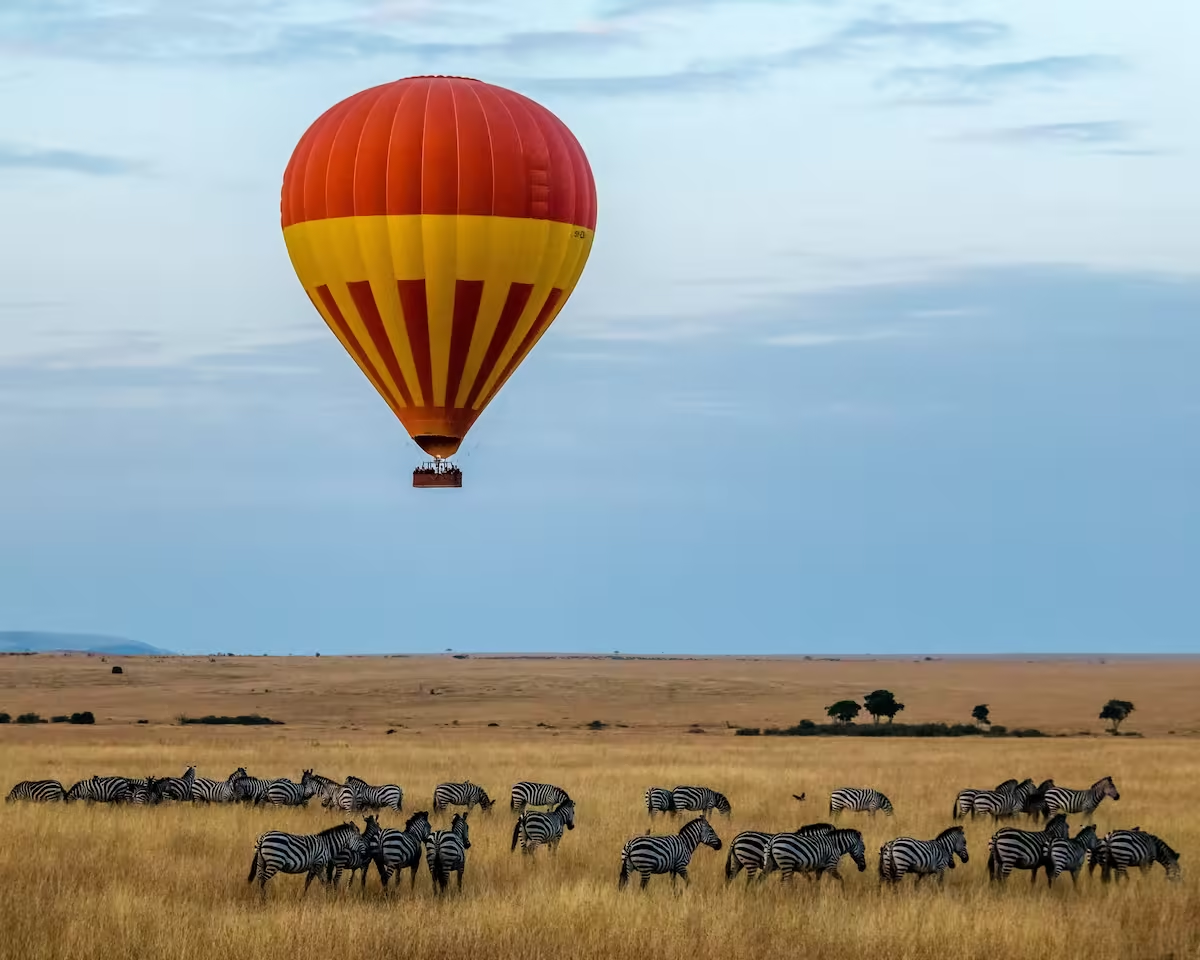
4-Day Serengeti and Ngorongoro Safari with Balloon
Arusha → Serengeti → Ngorongoro → Arusha
A compact route with the balloon flight added to a Serengeti game drive, for travelers who want the experience without making it the purpose of the trip.

Activity guide
One hour above the plains at sunrise, with a bush breakfast after landing. What a balloon safari costs in 2026, where you can fly, what the price includes, and whether it is worth adding to your itinerary.
Five established balloon destinations, from the Serengeti plains to the Okavango waterways. See the options →
Indicative 2026 prices by destination, what is included and why it costs what it does. Break down the price →
Who gets value from a balloon morning, and who is better off with another game drive. Read the trade-offs →
How to place the flight around camps, seasons and weather flexibility. Plan the day →
A hot-air balloon safari gives you a completely different perspective of the African wilderness.
Instead of following wildlife along a road, you rise above the landscape at sunrise, watching plains, rivers, woodland and herds unfold beneath you. The experience is particularly spectacular in the Serengeti, where balloon flights can reveal the scale of the ecosystem in a way that is difficult to appreciate from a safari vehicle.
A balloon safari is also one of the more expensive optional activities on an African safari, so the important questions are not simply what a balloon safari is, but how much it costs, where you can do it, what the price includes, and whether it is actually worth adding to your itinerary.
For travelers who value landscapes, sunrise photography, a quieter perspective and memorable experiences beyond conventional game drives, the answer can be yes. For travelers on a tight budget or on a very short safari, the same money may be better spent on an additional safari day.
Hot-air ballooning is available in selected wildlife destinations rather than in every African national park.
The most established safari balloon destinations are:
The experience differs considerably between destinations. In the Serengeti and the Maasai Mara the focus is on vast savannah landscapes and wildlife below, while in the Okavango Delta the aerial perspective adds another dimension because of the maze of waterways, islands, floodplains and woodland.
Balloons in the northwestern Okavango Delta launch around sunrise over the flooded landscape. The activity operates from selected camps inside the designated flying area and is seasonal, generally from April through mid-October.
Five destinations account for almost all commercial balloon flying on safari, and each one suits a different kind of trip.
| Destination | What makes it special | Best for |
|---|---|---|
| Serengeti, Tanzania | Endless plains, wildlife and sunrise landscapes | First-time balloon travelers |
| Tarangire, Tanzania | Elephants, baobabs and seasonal wildlife concentrations | Shorter Tanzania safaris |
| Maasai Mara, Kenya | Open grasslands and possible migration views | Kenya safaris |
| Okavango Delta, Botswana | Water channels, islands and wilderness from above | Luxury and landscape-focused safaris |
| Pilanesberg, South Africa | Volcanic landscape and Big Five country | Safari combined with Johannesburg or Sun City |
| Selected private reserves | Flexible launch areas and quieter airspace | Private and fly-in safaris |
The Serengeti remains the default answer for a first balloon flight, mainly because the flight path crosses wildlife country rather than farmland, and because the ground experience afterwards is built into a working safari day.
The Serengeti is arguably the most iconic place to experience a hot-air balloon safari in Africa.
The Serengeti is home to more than 1.5 million wildebeest, zebras and their predators, and sunrise balloon flights are offered among the park's visitor experiences.
A typical Serengeti balloon morning begins before sunrise. You are collected from your camp or lodge and transferred to the launch site. After take-off the balloon drifts with the wind over the plains while the landscape gradually becomes visible in the morning light.
The flight is generally around one hour. After landing, the traditional experience includes a champagne toast and a bush breakfast before you return to your safari vehicle and continue the day's game viewing.
For 2026, a shared Serengeti balloon safari is approximately US$599 per person with major operators. Published rates describe this as covering the balloon flight, early collection, launch transfer, champagne toast and bush breakfast.
A separate balloon operation fee applies in Serengeti under the park tariff, although older tariff figures are still quoted online and operators may incorporate applicable charges into the advertised rate. Always confirm the final price and inclusions at the time of booking.
A standard shared Serengeti balloon experience commonly includes:
Park entry and other safari costs should be checked separately, because they may already form part of your main safari package.
Balloon operations can be positioned in different parts of the Serengeti depending on the season and the operating area. Published operator information lists:
Availability is subject to weather, operating conditions and the location of your accommodation. This matters when planning a migration safari, because the best balloon location is not the same throughout the year.
Tarangire offers another ballooning option in northern Tanzania, and a different landscape underneath.
Instead of an almost uninterrupted sea of grass, you may see giant baobabs, woodland, seasonal rivers and large elephant concentrations. That mix makes the flight more varied than a purely open-plains morning, and it suits shorter Tanzania safaris where Tarangire is already on the route.
Hot-air balloon safaris are offered among the park's visitor experiences, and the Tarangire page covers what else the park is known for.
Published 2026 operator rates are around US$550 per person for a shared Tarangire balloon safari, although rates can change and should be confirmed when booking. Ballooning is particularly attractive when the park already forms part of a northern Tanzania itinerary.
The Maasai Mara is another major ballooning destination, with the same format and a different horizon.
The experience follows a similar sequence: an early-morning transfer, sunrise flight, aerial wildlife viewing and a bush breakfast after landing. The Kenya safari pages cover how the Mara fits into a wider route.
Published 2026 market prices generally place a shared Maasai Mara balloon safari in the region of US$450-600 per person, depending on the operator, season and exactly what is included. Because fees and inclusions vary, travelers should compare the final price rather than relying only on the headline flight rate.
The experience can be particularly appealing during the Great Migration season, but there is an important distinction: a balloon does not guarantee a view of a river crossing or of a particular animal, because it follows wind conditions rather than driving toward a specific wildlife sighting.
For that reason, the best way to use a balloon safari is as an additional perspective on the Mara rather than as a replacement for conventional game drives. Migration itineraries are set out on the Great Migration page.
A balloon safari in Botswana offers something different again.
The Okavango Delta is defined by water, channels, islands, floodplains and woodland. From a balloon, the landscape becomes a large aerial map beneath you, and balloons fly from treetop level to higher elevations with the winding channels and islands visible from above.
Because balloons launch around sunrise, guests normally need to stay in one of the camps located inside the designated flying area rather than attempting to arrive from Maun on the same morning. Balloon operations currently run from April 1 to October 15.
This makes an Okavango balloon safari particularly suitable for a fly-in luxury Botswana safari rather than for a short stopover.
South Africa offers ballooning in selected safari destinations, including Pilanesberg.
The Pilanesberg experience combines aerial views of the park's volcanic landscape with the possibility of seeing elephants, antelope, buffalo and other wildlife below.
Published 2026 rates for a one-hour Pilanesberg balloon experience are approximately R6,592 per international guest, plus the applicable park fee, with the whole experience taking roughly five hours including transfers and the ground programme.
This can work well for travelers combining a safari with Johannesburg or Sun City, and it suits a first balloon flight before a longer South Africa safari.
Balloon safari prices vary significantly by destination, operator, season, basket size and whether the flight is shared or private.
| Destination | Approximate shared price |
|---|---|
| Serengeti, Tanzania | US$599 per person |
| Tarangire, Tanzania | US$550 per person |
| Maasai Mara, Kenya | US$450-600 per person |
| Pilanesberg, South Africa | Around R6,592 per person plus the applicable park fee |
| Okavango Delta, Botswana | Usually packaged with selected luxury camps |
These figures are planning ranges rather than universal fixed prices. Balloon operators can change rates, and some quotations combine balloon fees, transfers, park or conservation charges and breakfast differently.
For example, Serengeti operators currently publish approximately US$599 for a shared flight, while private balloon arrangements can cost several thousand dollars for the entire balloon depending on capacity.
The price is not simply paying for one hour in the air.
A balloon operation is a small aviation business running in a remote area, and it carries costs that a game drive does not:
The result is an activity with considerably higher operating costs than a conventional game drive, and the price reflects that structure rather than the flight alone.
For the right traveler, yes. But it should not automatically be added to every safari.
A balloon safari is worth considering if you:
It may not be worth it if you:
The key point is that a balloon safari does not replace a game drive. A game drive allows your guide to follow tracks, stop at sightings, position the vehicle and spend time watching individual animals. A balloon does the opposite: you surrender control of the route to the wind and experience the landscape on a much larger scale. That difference is exactly what makes it special.
| Experience | Hot-air balloon | Game drive |
|---|---|---|
| Perspective | Aerial | Ground level |
| Route | Determined largely by wind | Guide chooses route |
| Wildlife tracking | Limited | Excellent |
| Landscape views | Exceptional | Excellent |
| Close animal encounters | Not the main purpose | Major advantage |
| Sunrise | Excellent | Excellent |
| Photography | Landscapes and herds | Animals and behaviour |
| Duration | Usually about 1 hour airborne | Several hours |
| Cost | High | Normally included in the safari |
| Best use | Special experience | Core safari activity |
The strongest itinerary normally includes both rather than choosing one over the other.
A typical morning follows a sequence similar to this.
In the Serengeti, published operator information indicates that guests can return to their safari guide around mid-morning after the balloon experience.
The flight itself is normally around 45-60 minutes, depending on destination and conditions.
The total experience takes considerably longer because of:
Plan on roughly four to five hours for the complete morning experience, although exact timing depends on the destination and your accommodation.
Ballooning is generally a sunrise activity, so the question is less about a particular time of day and more about choosing the right season and destination.
Serengeti: for general wildlife and landscape photography, the dry season can provide excellent visibility and wildlife viewing. June to October is the strongest period for migration viewing, and January to February for the calving season. See the Tanzania safari pages for route planning.
Great Migration: a balloon can add a spectacular aerial perspective during migration periods, but migration location changes continuously. If your objective is a Mara River crossing, do not book a balloon on the assumption that a crossing will happen beneath you on a particular morning.
Tarangire: ballooning can be paired with the park's seasonal wildlife concentrations, especially when elephants and other animals gather around available water.
Okavango Delta: the balloon season is tied to the operating area and weather conditions, with operations running from April through October.
A balloon safari is excellent for landscape and aerial photography, but it is not necessarily the best choice for photographers whose priority is close-up animal portraits.
From the air you can photograph:
The changing altitude can produce compositions that are impossible from a safari vehicle. However, the balloon moves with the wind, so you cannot ask the pilot to stop beside a lion or reposition repeatedly for a specific animal.
For serious wildlife photography, combine ballooning with a private photographic vehicle rather than replacing game drives with the balloon. See the Africa photographic safaris guide and the photographic safaris activity page for how those days are built.
A balloon safari works particularly well as part of a honeymoon.
A typical honeymoon itinerary could combine:
For Tanzania, a balloon flight in the Serengeti can be positioned in the middle of a longer safari before continuing to Ngorongoro, Tarangire or Zanzibar.
The balloon itself is not necessarily the most romantic part of the experience. It is the combination of sunrise, silence, wilderness and a private celebration breakfast that makes it memorable. Honeymoon routes are set out on the honeymoon safaris page.
For travelers visiting Tanzania from Zanzibar, a balloon safari can be incorporated into a mainland safari before returning to the island.
A practical combination might look like:
Zanzibar → Serengeti → Ngorongoro → Zanzibar
or:
Zanzibar → Tarangire → Serengeti → Zanzibar
The balloon should be scheduled on a morning when you are already staying close enough to the launch area. It should not be treated as an activity that can simply be added to a long transfer day, because flights begin before sunrise and depend on weather. Combinations are set out on the safari and Zanzibar page.
Four itineraries show how a balloon morning is usually built into a safari. Every one of them can be shortened, extended or finished on the coast.
Arusha → Serengeti → Ngorongoro → Arusha
A compact route with the balloon flight added to a Serengeti game drive, for travelers who want the experience without making it the purpose of the trip.
Arusha → Tarangire → Serengeti → Ngorongoro → Arusha
Tarangire, a Serengeti balloon morning plus game viewing, and the crater, with more time in the Serengeti than the four-day version.
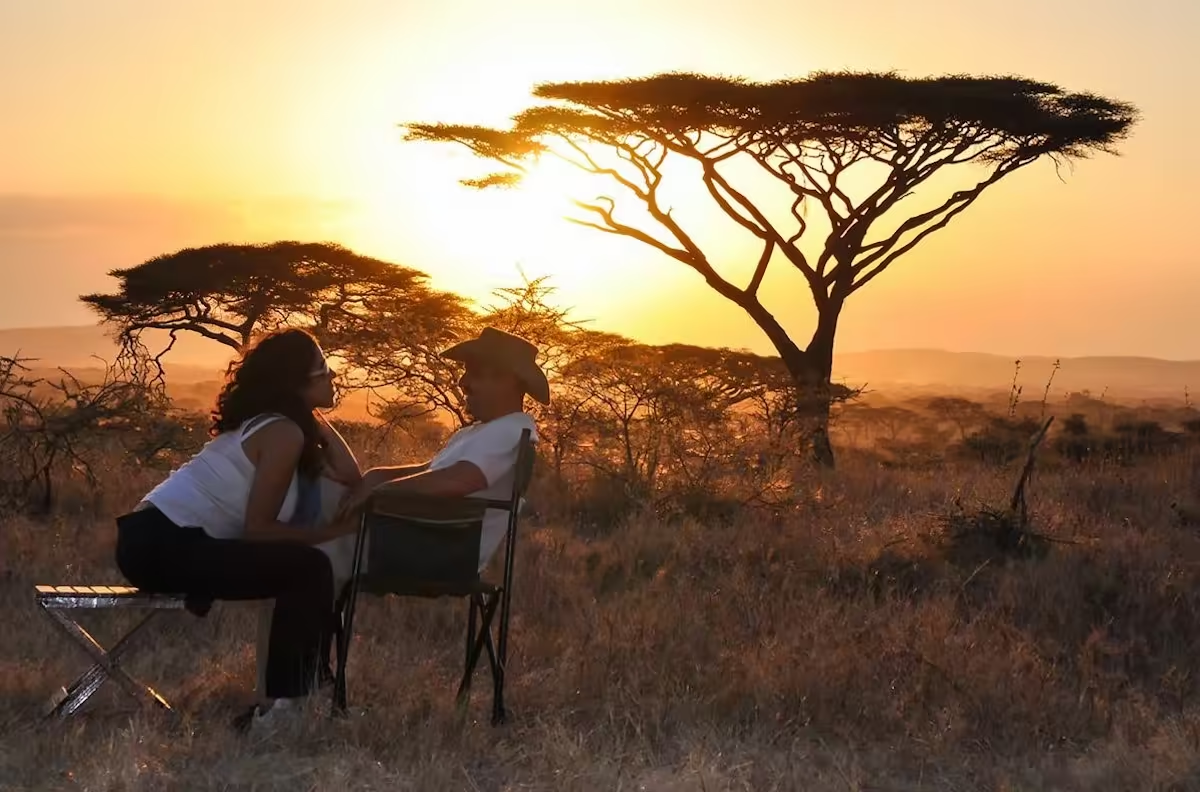
Arusha → Tarangire → Ngorongoro → Serengeti → Zanzibar
The balloon sits in the middle of a longer safari with private touches, rather than replacing valuable wildlife time.
Most travelers use a shared balloon.
A private balloon can be arranged in some destinations, but the price is substantially higher. A private experience may make sense for:
Published 2026 private balloon rates run into several thousand US dollars per balloon, depending on passenger capacity. For most travelers, the shared balloon provides the best balance between experience and cost.
Longer Tanzania routes and luxury Serengeti weeks, all of them adaptable around your camps, the season and the operating area.
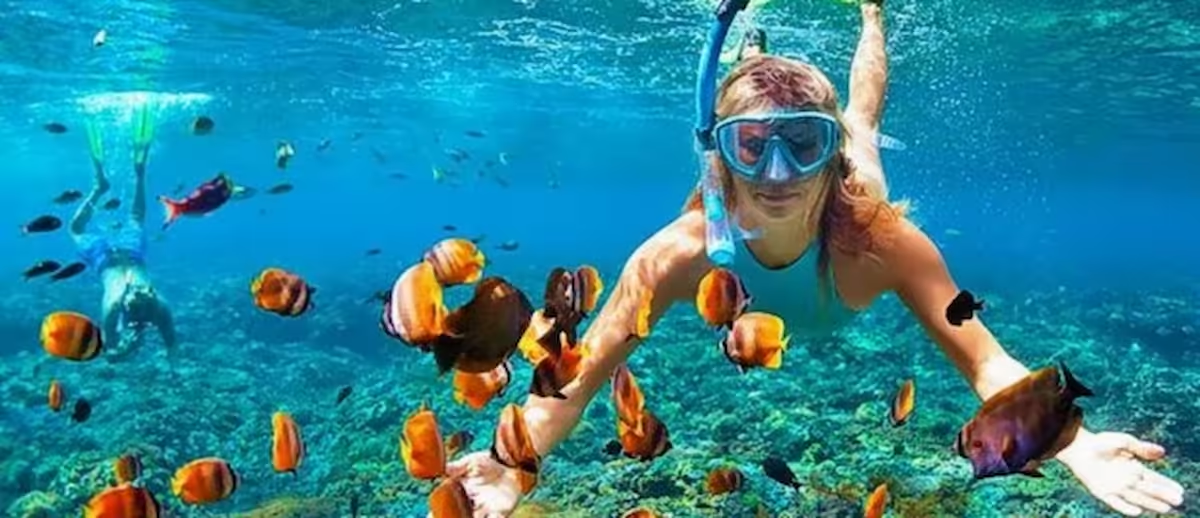
Tarangire → Ngorongoro → Serengeti → balloon morning → Zanzibar
Tarangire and Ngorongoro first, the balloon on a Serengeti morning, then a beach finish on the Indian Ocean.
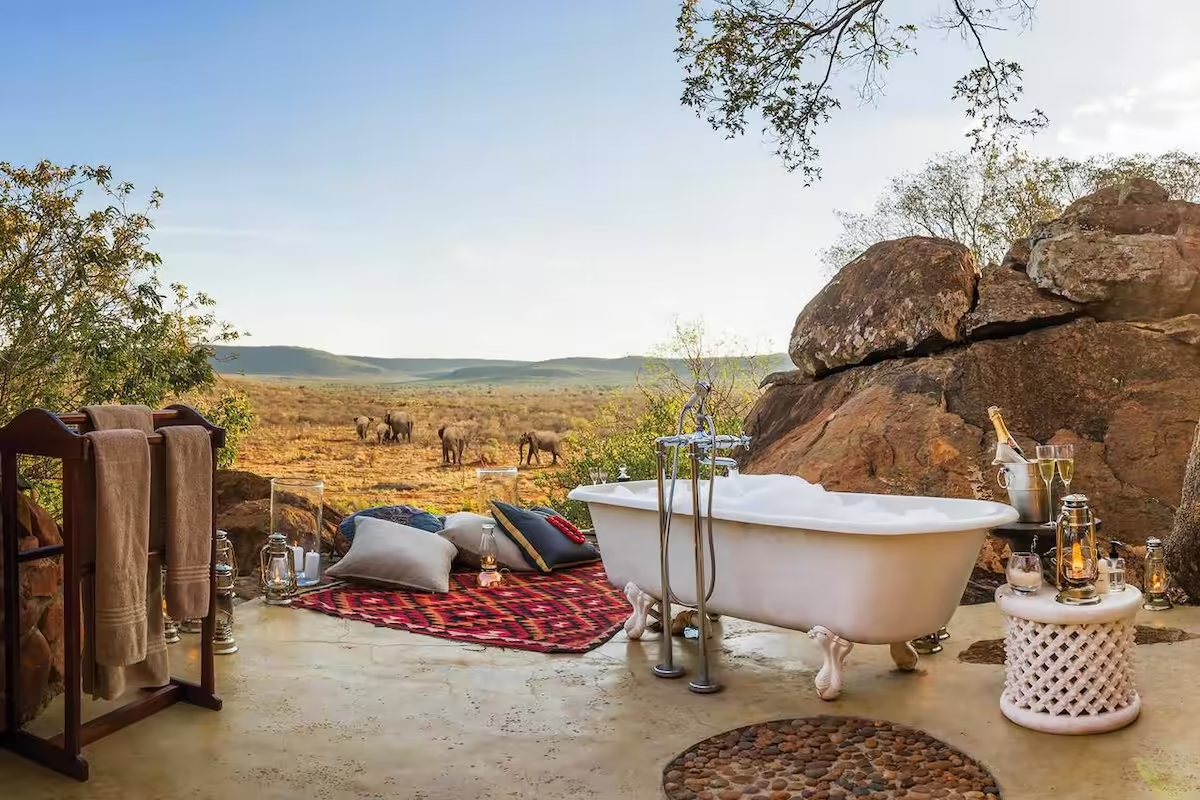
Serengeti → balloon morning → Serengeti → Ngorongoro
A luxury week in the same wildlife country, with the balloon flight slotted into the camp programme rather than added to a transfer day.
Age and physical requirements vary by operator, so the rules for one destination may not apply to the next.
Some current Serengeti operators accept children over seven and ask passengers to be reasonably mobile and fit. Requirements can include:
Always confirm the requirements with the operator before booking, especially for young children, older travelers or anyone with mobility limitations.
Hot-air ballooning is weather-dependent, and the pilot makes the final decision on whether conditions are safe for flight.
Possible reasons for cancellation or postponement include:
This is another reason to schedule the balloon early enough in the itinerary to allow some flexibility. Do not build an entire safari around a balloon flight that has no alternative date.
Dress for the early-morning safari rather than for the warmer conditions you may experience later in the day.
Temperatures can be surprisingly cool before sunrise, particularly in the Serengeti. Avoid bulky clothing that makes getting into the basket difficult.
Keep your equipment compact, because large luggage normally stays at your accommodation.
For photography, a versatile zoom lens is generally more practical than carrying an entire camera bag into the balloon.
Commercial safari balloon operations use specialized equipment, trained pilots and ground crews, and flights are conducted subject to weather and operational conditions.
Balloon operations in Tanzania are conducted under civil aviation rules, and pilots hold commercial balloon pilot licences.
Travelers should nevertheless follow all operator instructions and disclose relevant mobility or medical concerns before flying. The most important safety decision is whether the pilot considers conditions suitable for flight.
Balloon flights have limited daily capacity, so they should be booked before the safari.
Book well ahead especially during:
Some operators recommend booking many months ahead because seats sell out during busy periods. Waiting until you arrive at camp can work when space remains, but it should not be the strategy if the balloon experience is important to your trip.
Three questions settle it.
If your priority is simply seeing as many animals as possible, put more of your budget into additional safari days, better positioning or a private vehicle.
A balloon safari works best when it is treated as part of the itinerary rather than as an isolated excursion.
The planning should consider:
For a tailor-made safari, the balloon day can be positioned around the rest of the route so you do not lose the best opportunities for conventional game viewing. Tailor-made planning is covered on the tailor-made safaris page.
| Traveler | Best destination | Why |
|---|---|---|
| First-time safari traveler | Serengeti | Iconic landscapes and wildlife |
| Honeymoon couple | Serengeti or Okavango | Sunrise and luxury experience |
| Wildlife enthusiast | Serengeti or Maasai Mara | Large-scale wildlife landscapes |
| Photographer | Serengeti or Okavango | Strong aerial compositions |
| Family | Destination and operator dependent | Check age and mobility rules |
| Luxury traveler | Okavango or Serengeti | Easy integration with fly-in camps |
| Short South Africa trip | Pilanesberg | Works well with Sun City and Johannesburg |
| Migration traveler | Serengeti or Maasai Mara | Aerial perspective on migration landscapes |
Where the flight matters to the trip, request a proposal with your dates and camps, and the balloon morning is placed before the rest of the route is fixed.
Prices vary by destination. In 2026, a shared Serengeti balloon safari is around US$599 per person, while Tarangire is around US$550. Maasai Mara prices commonly fall around US$450-600 per person depending on operator and inclusions.
Balloon safaris price per seat, not per camp: a shared basket over the Serengeti runs around US$599 in 2026 with champagne landing included, Tarangire near US$550, and Mara baskets US$450-600 depending on operator. Private basket hire exists but multiplies the seat price several times over.
The flight itself is normally about 45-60 minutes, but the complete morning experience can take around four to five hours including collection, transfer, preparation, breakfast and the return.
For travelers who value aerial landscapes, sunrise and a unique safari experience, it can be one of the most memorable additions to a Serengeti itinerary. It is expensive, however, and should not replace essential game-drive time on a short safari.
Yes, you may see migration herds from the air when they are in the area of your flight, but their location changes continuously. A balloon cannot guarantee a particular herd or river crossing.
Age restrictions vary by operator. Some Serengeti operators accept children over seven, while other operators or destinations may have different rules.
No. Flights depend on weather and operational conditions, and the pilot makes the final decision on whether conditions are suitable.
Usually not. Most standard balloon safaris use shared baskets. Private balloons are available in selected destinations but cost substantially more.
Most classic safari balloon experiences finish with a bush breakfast, often accompanied by a champagne or sparkling-wine toast, before guests return to their safari vehicle.
The balloon itself operates near the safari destination rather than from Arusha city. You normally need to be staying near the launch area the night before, because flights take place around sunrise.
Yes. A balloon safari can be incorporated into a Tanzania safari before flying to or from Zanzibar. It is best to schedule the balloon while you are already staying in the relevant safari area.
For Tanzania, the Serengeti is the strongest choice for travelers who want the classic balloon morning: sunrise over vast plains, wildlife below, a bush breakfast after landing, and the chance to continue the day's game drive afterwards. For the Okavango Delta, ballooning offers a completely different perspective of waterways and islands, while in Kenya the Maasai Mara pairs the same sunrise experience with one of East Africa's most famous wildlife landscapes.
A balloon safari should be chosen according to where you are staying, the season, your safari priorities and your budget. The important thing is not simply to add a balloon because it sounds impressive: place it in the right part of the itinerary, allow enough time for the experience, and make sure the rest of the safari already gives you the wildlife time you want.